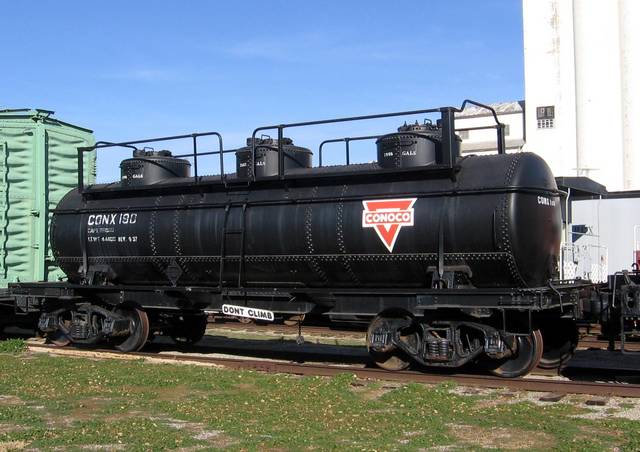
One of my favorite types of rolling stock is the multi-dome tank cars that were commonly used from the 1920s until post WWII when truck traffic knocked the less than car load business off the railroads tally sheet.
Some pictures for inspiration and reference.


Rivet detail.


Vents

My main take a ways are the double rivet lines separating the internal tanks, the full length walkway and the handrail on the Texaco car.
Prototype in narrow gauge for multi-domes are rare. I have been told by a White Pass modeler that two triple domes were owned by that line and used for MOW service. I have not been able to verify this with either records or photos. An example for which there is evidence is this two dome owned and operated by the D&RGW.

Tank cars date back to the earliest days of railroading. They were originally open top vertical tanks made of wood and were used to haul crude oil. These washtubs on wheels shared the rail with barrel carriers until the advent of the horizontal riveted tank car in 1869. This is the car most commonly modeled on pre-WWII layouts. The tank mounted flat car could be found on railroads well into the 1940s but its progeny was introduced in 1901 as John Van Dyke’s riveted frameless tank car. Using a V shaped saddle at each end of a riveted steel tank the new cars eliminated the wooden flatcar and let the tank itself supply structural stability. They were not well received by the railroads and less than 100 of the new-fangled things were built.
Van Dyke followed up his V car design with a throwback framed version called the X frame. It differed from the V cars in that it had a center sill steel frame running the length of the car under the tank. In 1924 the D&RGW converted 30 of the standard gauge cars for narrow gauge use. Some used the Van Dyke saddle design and became narrow gauge frameless cars while others had the frame split to allow the tank to sit lower giving the car better stability. The latter group became known as framed tank cars. Both types remained in use until the demise of the D&RGW narrow gauge lines. Bachmann has made excellent models of both of these cars as part of their 1/20.3 Spectrum line.

I run a great number of tank cars as part of my interchange traffic with the D&RGW as well as the RGS. The triple dome represents a private car owned by the Oso Grande Oil Company (my made-up regional oil producer) used to supply petroleum products to its gas stations and various bulk customers across Northern New Mexico. The three compartments will be Ethyl, Regular and Diesel.
For this build I will be starting with a Bachmann Spectrum framed tank car in oxide red. Not that it matters as it will need a full repaint at the end.

I began by removing the dome and vent and making a mold for both out of RTV. Not very economical of me but I was not going to scratch build three domes. I then cast three new domes and vents. I thought of using the original but I already had it set up as a master for molding and decided to leave it in the archives for future use. Here is what the car looks like before the real work began.

The car is now disassembled and ready for conversion. Let me point out now that these cars are much sturdier in design and material thickness than the Big Hauler line. It made what came next much more difficult than I was expecting.
I measured and marked where the additional domes would sit. There is a lip on the bottom of the domes so the hole had to be slightly smaller than the main body. This lets them all rest at the same height supported from the base.
To make the holes I first drilled a 1/8″ pilot hole to keep the next bit from walking down the curved side of the tank. The enlargement was done with a 1/2″ bit. This allowed me to cut the lines with a piece of hacksaw blade out to the full diameter. I made sideways cuts to help break out the sections of plastic and then sanded it into the final shape.

To make the reinforcing ring at the base of the domes I drew a pattern on 1/6″ polystyrene and cut them out with scissors. These were glued on with acetone. I counted the rivets on the center dome and then made index marks on the new rings. This helped with spacing and placement of the holes for the rivets. I drilled each hole with a 1/64th bit in a pin vise and then enlarged each hole with a cut off track nail. The holes were now large enough to allow the rivets to slide in with a snug fit without splitting the plastic.
Using the pin vise was tedious and took me several sessions to drill all of the holes. I considered using the drill press but was afraid it would break the bits.
For rivets I am using Atlas HO round head track spikes. They are almost identical in size and shape to the molded on rivet heads. The project requires almost 650 of them.
In addition to the dome rings I added a row of rivets all the way around the tank in four places. This made every row double to represent the practice of the 1920s. Once finished I glued the rivets in place by running a line of super glue on the inside.

With the rivets done I was ready to glue the domes in place. Starting to look pretty good.

I started this car many years ago. Seemed simple at the time. Add two domes to an RTR model and BIF, BANG, POW; I would have a cool kit-bash. It has not gone that way. The domes did not mold all the detail well so they will need rework. The walkway is proving to be a bear since they attach only on the thin metal supports and the connections under the car are interfering with the trucks. Painting is also a serious effort. Because of the handrails, ladders, and open frame I will have to paint the entire car in pieces and then reassemble it before doing any weathering. No wonder this has become a shelf sitting dread knot monster.
Here it is spread out on the paint table daring me to work on it.

The walk way supports are attached with track nails and glued from the back.

The closure bolts seem to basic. I may redo them as locking dogs with handles.

The domes only have one line of rivets on the side. Since the last dome faces the other way to keep the vent from sticking out I feel like I should add a second line of rivets for aesthetics.

Okay I have done the easy part, I’ve spread it across the bench, griped about it and posted it on line. I guess tomorrow I will start working on it. 


 awesome work and always can learn some new places to get supplies. Thanks for the ideas!, and the good work!