Large Scale Central

Signals on the NVRY

They look soldered to me - if you download the image and zoom in with a photo viewer, you can see the solder fillets on each pin that give it away.

You can get sockets for the large chips at the top of the board, but you’d have a tough time finding a socket for the ESP32 module since it’s not a standard package.

They are soldered, though on a complex board I’ll use sockets and headers in case I’ve made a mistake. Here’s the control point node with pin headers as a socket for the ESP32 dev board.

Can’t believe I forgot about using single-row headers as a socket for various modules. It’s too early in the day still I suppose…

1 Like

Everything on the “back” side of the board assembled, and everything tested. I have to wait for some LED bezels to show up to finish the “front” of the board, then I can finish this one up and see how it looks mounted.

2 Likes

The signal and turnout switches are round shaft. Reproduction metal levers are about $14 a piece, and I ain’t paying that.

But, I found a nifty brass sleeve with a set screw designed to heat insert into plastic, to make your own.


They’re good enough for now. Just need to print up a bunch of them.


1 Like

That looks good, Bob! You make me want to play with this type of thing more…

Hard to get a decent picture without glare. The LED bezels came in today. Out of the package they’re black, but chrome is prototypical. A bit of silver paint pen solves that problem.

Now that I have the bezels, I measured the spacers needed for the LEDs to be set into the bezel. 10.5mm seems to be right. Printing a set of those right now and I’ll be able to do the final assembly of the first board.

2 Likes

Assembling the LEDs:

First one soldered in place:

Board assembled. Now to finish up the software and get it installed in the panel.

2 Likes

1 Like

Prototype of the middle section of the model board. From left to right, Burke Yard, future branchline, Williamsport with passing siding and future branchline, and the branch down to Majestic. This is as far as I’m planning for this year. Next steps will be to get detection figured out.

1 Like

Can’t you just mix the red and green in the right proportions?
That’s how televisions do it and that’s how I do it on the Tortoise Bump system.

Starting to tie everything together in JMRI. Getting the programming working for the two switches and surrounding blocks that are the first.

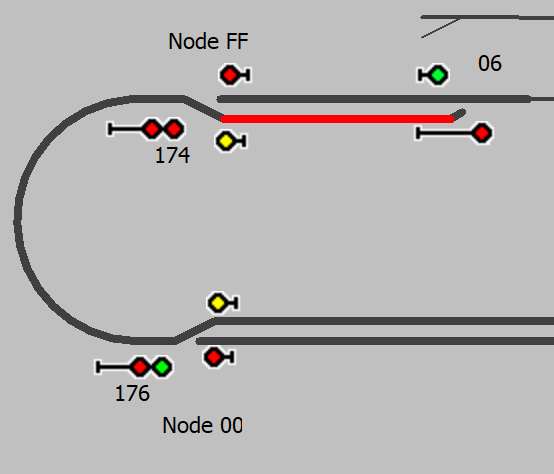
Let’s say I’m sitting on the siding at Williamsport, headed for Burke yard. You can see the track is red, indicating where I am. The signal in front of me is red, because the switch is lined for the main.
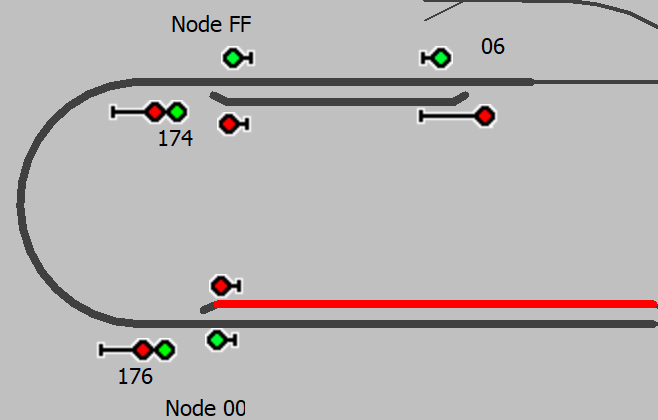
image

If we throw that switch for the passing siding, the signal goes green.
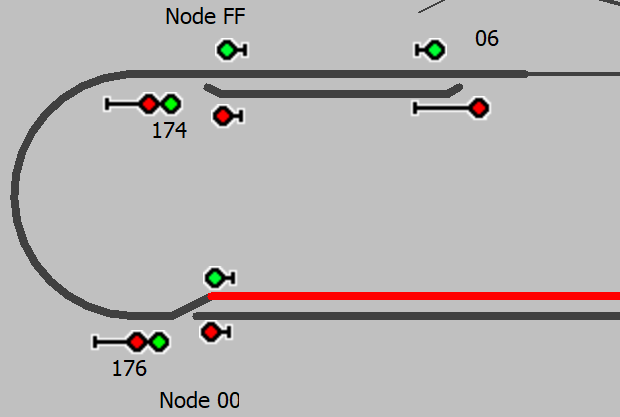
image

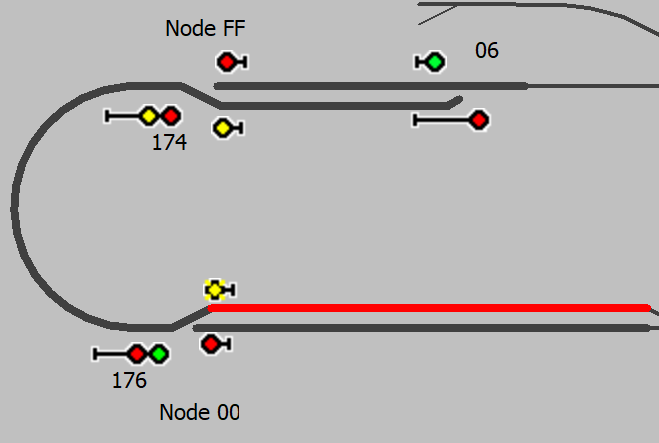
Looking ahead to the switch at Burke, it’s lined for the main, so we currently have green all the way past Burke. But, we want to go into the yard, so lets throw that switch.
image

Now the signal in front of me is flashing yellow (Advanced Approach), the next signal at Burke is red over yellow (Diverging Approach)

If we move into the next block, the signals behind me drop to red (Stop) and the signal in front of me is still Diverging Approach, so I can enter the yard.
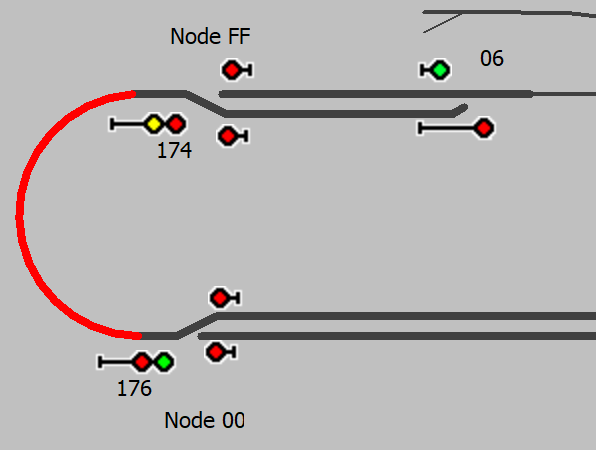
image

Once I’m in the yard, the signal behind me drops to Stop, and the signal at Williamsport goes to yellow (Approach)
image

2 Likes

Where does the gauge fit into the over all panel scheme? You also need a table under the panel to hold the ashtrays!

Bob, are you “telling” JMRI where you are and how the switches are lined up, as part of the programming for your signals? Or have you already set up sensors up to feed JMRI actual conditions? Either way, fascinating!

The block detection and the switch position are both fed through the wifi nodes that I’m working on. When I want a signal to be ‘active’ I ground that pin, since that’s what, ultimately, the hardware will be doing once it’s all out in the garden (see previous posts about the cpOD block detectors and the switch position detectors)

So the screen here in JMRI is just responding to inputs from my hardware.

1 Like

I guess I should talk about signal aspects, and what they mean. Railroad signals are not like traffic lights.

  • Green (Clear): The upcoming block(s) are empty. Proceed at authorized track speed.*
  • Yellow (Approach): The next signal is Red. Proceed at restricted speed and be prepared to stop at the next signal.
  • Flashing Yellow (Approach Medium): Indicates the second signal ahead is Red.
  • Red (Stop): The block immediately ahead is occupied, or a turnout is thrown against the route.
  • Flashing Red (Restricting): Used to indicate entering a yard, siding, or occupied block at restricted speed.

This is a very small subset of actual signaling rules, but it works for many model railroads.

Bob,
An approach medium will also indicate that the next CP has a crossover happening.

A yellow approach means approach the next signal prepared to stop but not at restricted speed but rather reduced speed.

A restricting signal means the train is entering a non signaled territory, generally know as “other than main track”.

I’ll also point out for those that don’t know, signals generally go most favorable condition on top. So Green, Yellow, Red/Lunar on a 3 light mast.

Why does the JMRI give you a clear signal for movement in the opposite direction? It should be red on 176 for movement into Williamsport.

1 Like

Ah, I haven’t programmed 176 entering WP yet, because I don’t have the signals set up on the other end of the siding. Nice catch! :slight_smile:

And thanks for clarifying restricted vs reduced.

EDIT: The JMRI simple rule set seems to be a subset of the NORAC rules.

https://www.trainweb.us/eastpenn/norac/norac.html

This is really amazing, and totally over my head. When you have the panel set up with the switches and leds, are you also going to have the monitor as part of the set up showing the blocks / signals in addition to the panel? Or is the graphic interface just for programming?

Ahh yes the wonderful world of world of signaling and East Coast speed signaling vs the west coast route signaling that I’m used too. Or maybe it’s the opposite. I just remember there’s just enough difference between the two to confuse me.

Probably the same reason why east Coast RR use even numbered frogs and the East Coast uses odd numbered frogs… :man_shrugging:t3::thinking: