Looks great again Ray. Is that 2nd floor going to be the doctors office, as it seems it would fit in.
Dave
Looks great again Ray. Is that 2nd floor going to be the doctors office, as it seems it would fit in.
Dave
Nice…
Jon.
…winking…
Thanks. The second floor will be a former “house of ill repute”, now turned into a private residence.
No new pics, but here’s a brief update…
I built up some electric meters, smoke jacks and a few other small exterior details. Since I’ll need these for many of my buildings I decided to mold them so I can cast duplicates. Then I discovered that my silicone mold compound has turned to rubber in the jar. Doh! I hate the short shelf-life of that stuff.
A while back someone posted pics here of some bottles they turned from acrylic rod. My first attempt at this several months ago failed, but those pics and the info supplied inspired me to try again. Success! I’ve managed to make a half dozen or so already, just between other projects. Also, I remembered reading the posts in another forum from the Polish aircraft modeler, who mentioned that he used toothpaste to polish parts. So I used that to smooth the bottle after shaping them. Turned out real nice.
Now I’m working on a swamp cooler (old fashioned evaporative cooler that predates modern air-conditioning). Maybe I’ll mold that too, when my shipment of mold compound gets here. Lots of old desert buildings used swamp coolers.
Last night I found out that three of the lights inside my rock shop had burned out prematurely, so I’m replacing those and trying figure out how to prevent it happening again.
LED’s?
Jon.
I’d love to be able to use LEDs, but there are too many obstacles. First is size – they’re a LOT bigger than a grain of rice bulb. Then there’s the leads – bulbs have of a pair of thin, closely spaced wires that can be run through a narrow brass tube or otherwise disguised/hidden. Can’t do that with an LED, which has those thick, widely spaced metal prongs.
The wiring is more complicated too, and I haven’t a clue as to what kind of resistors you’re supposed to use or how to use them.
We still use swamp coolers! What a great thing to model.
I’ll be curious what you do on the lights. That’s one of my winter projects,
I was going to use the yellow grain of wheat to look like kerosene lights but I don’t want that short usage time.
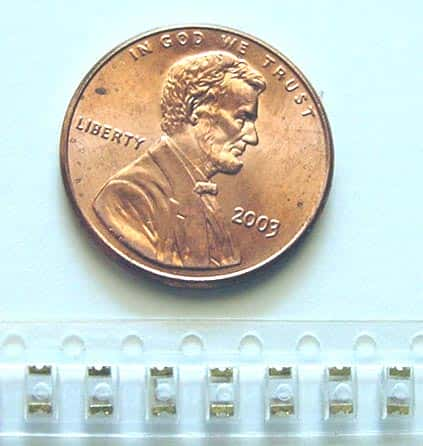
LEDs are not hard to work with. You just need the specs for the LED–the amount of voltage it’s rated for, and the forward current it’s rated for, in milliamps. One I know that, I just use this online calculator: http://led.linear1.org/led.wiz Enter the number of LEDs in your circuit, the source voltage, and the specs of the LEDs, and viola. I’ve used a lot of warm white lights from a string of Christmas lights. I assume the specs are roughly the same as the white leds listed at radio shack, and go from there. I power them from the track, which is at 21 constant volts Surface mount LEDs are REALLY small:
(http://www.westfloridacomponents.com/mm5/graphics/LEDsmred1206.jpg)
I’ve had good luck painting white LEDs to control the color. These are christmas-string leds painted poly sclae reading yellow
(http://chnm.gmu.edu/courses/magic/westover/images/greendark1.jpg)
My main interest in using LEDs is reducing current draw, since I run a lot of lights from the track
mike omalley said:
I’ve had good luck painting white LEDs to control the color. These are christmas-string leds painted poly sclae reading yellow(http://chnm.gmu.edu/courses/magic/westover/images/greendark1.jpg)
My main interest in using LEDs is reducing current draw, since I run a lot of lights from the track
That looks excellent. I have one coach that was converted to LED’s and I’ve never liked it because it looked like modern fluorescent lighting. I will have to try your paint method on that coach.
mike omalley said:The entire circuit, or just one building? All my structures are powered from a single source, so the number of lights will always be changing as more structures are added to the layout.
Enter the number of LEDs in your circuit, the source voltage, and the specs of the LEDs, and viola
mike omalley said:They don't look much like light bulbs, though. How difficult is it to solder leads to those?
Surface mount LEDs are REALLY small
I think the problem with the lights that burned out might have something to do with the leads. All the other lights in the structure have long, thin leads. The ones that burned out, the leads were cut short and soldered to parallel brass rods. Same thing happened in my hoist house a while back too. So I’m going to try redoing them in a way that eliminates the brass rods and just uses the thin leads.
Ray the resistor just goes in series the lights–let’s say you have made a new building, and it has 6 leds in it,a nd each on is rated for 2.5 milliamps at 3 volts. Your source voltage–let’s say it’s the track–is 21 volts. You would need one 1200 ohm resistor. The LEds are connected + to minus, and the resistor is on the last leg. You don’t need to change the resistor unless you add more leds to that string. You could add a second string to the building, and if it had three of the same leds in it you would put a 5600 ohm resistor in the second string, while leaving the first string alone. I agree they don’t look much like lightbulbs, and sometimes they are a little harder to work with. And they cost more. The big advantage is the very low power consumption, and if they’re matched to the right resistor they will pretty much last the rest of my life. On my layout, where there are a lot of track powered lights, I want to decrease the number of amps drawn by, say, a passenger car or a building. This would be even more true if I ran on batteries Three 5mm xmas light leds:
(http://chnm.gmu.edu/courses/magic/westover/images/towernight.jpg)
But you are a WAY better modeler than me and you manage a much higher degree of detail and accuracy than I do, and it’s true it’s sometimes pain in the butt to wire up LEDs Dave Bodnar has a tutorial on surface moutn leds here: http://davebodnar.com/railway/LED_light_project/ I’ve never tried it–I’ve only ever used 3mm LEDs. In the picture below, the red lights are 3mm leds from radio shack inserted in two aristo marker lights
(http://chnm.gmu.edu/courses/magic/westover/images/h8sm.jpg)
I am using LEDs in some buildings.
I chose LEDs because I didn’t want to run more wires or take power off the track.
I can use batteries, and no resistor needed.
You can order them pretty darn cheap off eBay.
The people I bought from were straight out of China. I think their eBay name was “we honest”.
I need to buy some more. I have a bunch of coaches and buildings to light.
The LEDs will also work over a fair range of (low)voltage. I don’t rememember what size resistor I used when I tested the LEDs.
But one LED w/R would light at 2.5 volts and I tested it up to 12 volts.
Ralph
Ray Dunakin said:Ray, considering your talent and attention to detail this has struck me as needing to see details of before and after. Your fixing up an old house ....... right??
Thanks. The second floor will be a former "house of ill repute", now turned into a private residence.
You should have know that stating an ex “house of ill repute” was gonna trip my trigger!
Sorry back to your LED debate!

mike omalley said:Assuming I could figure out what resistors to use, and then got some, how do you hook them up? Can they go either direction? If not, how do you tell which end is which? The resistors I've seen just look like tiny striped cylinders with a wire sticking out each end.
Ray the resistor just goes in series the lights--let's say you have made a new building, and it has 6 leds in it,a nd each on is rated for 2.5 milliamps at 3 volts. Your source voltage--let's say it's the track--is 21 volts. You would need one 1200 ohm resistor. The LEds are connected + to minus, and the resistor is on the last leg. You don't need to change the resistor unless you add more leds to that string. You could add a second string to the building, and if it had three of the same leds in it you would put a 5600 ohm resistor in the second string, while leaving the first string alone.
mike omalley said:Yeah, the long life of LEDs is the most attractive feature. Low current is good too but not a big issue for me since I wouldn't be running them off batteries or track power.
I agree they don't look much like lightbulbs, and sometimes they are a little harder to work with. And they cost more. The big advantage is the very low power consumption, and if they're matched to the right resistor they will pretty much last the rest of my life.
Ray, I’m not an electrical engineer but I’m sure the guys here who are will quickly correct me if I’m wrong. Resistors aren’t polarity sensitive–they work no matter which way they are hooked up. That calculator I linked to will tell you the right value, if you have the specs on the LED. There are only three things you need to know–the source voltage, the LEDs max voltage rating, and the LEDs forward current rating. You just solder one end of the resistor to one leg of the LED, and then connect power to the other end of the led and the other leg of the resistor
For example, with warm white LEDs I’ve found that I need a 1kohm resistor to run one LED from the 21 volts on the track. So–solder a wire to the resistor, either end, solder the other end of the wire to one leg LED; solder a second wire to the other leg of the LED. Then connect one end of the resistor to the + track and the wire to the - track, and it lights up–or it doesn’t, in which case I switch the wires.
Resistors are color coded for value, but I’ll be honest–I have a very hard time reading the color codes. I have to look them up, and on a small resistor it’s often hard to tell red from purple from brown
Mike. You have the same problem as me. I ALWAYS use an ohmmeter to measure the things if I am not sure what they are.
Thanks for all the info, Mike.
Ray, check out my website for some basic stuff I did with LED’s. And do some Google searching. It’s really not hard stuff. But, be warned, once you go with LED’s you won’t want to go back to the old lighting methods.
As noted earlier, you can paint the LED’s to change color casts. LED’s have almost no heat because they use almost no current. No current = no heat. Another thing you can do with LED’s is cut them. I’ve made projects with my kids where you glue a LED into a building, car, laser gun, school project etc then you cut the LED or file/sand it to a new shape. You’d be amazed at how well LED’s work for headlights or tail lights that need to be molded into a model car body. We even used LED’s and fiber optic threads to make simulated sparks and a entry light in a .45 pistol being held by a GI Joe action figure for a school project one time too. My daughter got an A+. LED’s also last for years and years of use…
For your buildings you could figure out how many lights (LED’s) you want in total. Wire them all together in series. Figure out how many volts/current the complete circuit would need to run from your constant power source and we can tell you what resistor is needed to make the circuit work. Add the resister (if it’s even needed) then place the building on the layout and plug it into the power source. Done.
Jon.