Large Scale Central

Signals on the NVRY

I’ve been experimenting with two different detectors. The NCE BD20 (top), and the cpOD from Model Railroad Control Systems (bottom). The cpOD is a bit nicer because it has a potentiometer to set the sensitivity, and seems to work a bit better in testing.

Once I get to that stage, I’ll be doing more in-depth testing to see what works the best for me.

Cool. I have a couple BD20’s but haven’t tried them yet. Do they not need DCC or any track power to operate? If not that would be awesome.

Hey do need DCC in the rails to work. They sense a current draw. As I’ve been rebuilding the RR I have been putting the layout into electrically isolated blocks, and I am just starting to experiment with various conductive epoxies to put resistors across the wheelsets on my rolling stock.

Good deal. FWIW, if & when I go to all-battery, I intend to keep DCC on the rails as an aux power bus and also for DCC control of stationary gear.

Here we have v2.0 of the 3 light dwarf signal. Less bulk, and a bracket to attach to benchwork or other support system. This one is wired to what will be my standard signaling harness. An IP67 connector with 7 pins (ground, plus 2x red/yellow/green for signals). This harness is for testing, and will be shortened to about a foot long when I put these all out on the RR.

This dwarf signal is the one when you leave Burke, traveling on the main.

Your outta control !!

Also known as “retired”.

2 Likes

have you ever thought about using infrared light barriers?
(as used for moving stairs and/or alarm systems)

Detection needs to be absolute, and its tricky. An IR detector is by its nature an “event” driven detector. It will only tell me “something blocked the light just now.” It wont tell me “is there something sitting on this piece of track?” Which is what we really need for signaling to work correctly.

If there is an errant boxcar sitting on a passing track, for whatever reason, and the end of my last session, and I start up the layout and want to run operations, I need to know of that boxcar is there now.

understood. thank you.

On the subject of signals, and protection, we should talk about control points.

A control point is anywhere on a railroad that we need to control access. Commonly this is at a switch, either at a passing siding or a branch line. But the nomenclature for these is the same

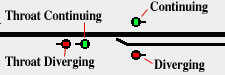
Approaching a switch you can take two possible branches. In RR terms these are called “Continuing” or “Diverging.” i.e. “am I continuing on my path or diverging from it?”

“Continuing” is implied when we talk about signals. If I “take the siding” this is called diverging. This diagram explains it.
image

So, for example in my signal testing a few posts up, “Clear” means I have a green signal to continue on going in the direction I want to go, at whatever track speed is appropriate.

“Diverging Clear,” on the other hand would tell me “I am cleared to the diverging route on the switch at track speed”

“Throat” means that I am approaching the switch where I can go one of two directions.

DO YOU UNDERSTAND THIS JON???

Of course. Go back up a few posts to where he is programming JMRI and I’m completely lost!

I have learned a lot about signaling from these posts. It’s a very confusing subject to me as there are so many different standards from back in the day when there were more than a few major railroads.

1 Like

You confused me on this. Isn’t the throat the single track that the main and diverging track go into when they are headed towards the track you labeled throat
In a search i came up with:
In this context, the “throat” refers to the area of a rail yard or junction where multiple tracks converge into a smaller number of tracks, typically leading into a station platform area or a main line

Doing some preliminary design work on the hardware for the CTC panel. I’ve been using the free version of EagleCAD for years, but it’s limited to the board size you can create. So I’ve switched over to KiCad. A bonus is that it has a nifty built-in 3d board viewer.

1 Like

How to complicate your garden railroad in 738.5 easy steps :smiley:

Joking only Bob, it has been interesting and informative following along as you develop this system.

738.54321 and 7/64ths to be correct Mr Marty!

It’s something I’ve wanted to do for more than 10 years. Having run on various RRs with operating signals, it adds a lot visually. I think I can scale down the logic to have it work on smaller layouts like I have. It’s definitely been an adventure.

Why, yes, I have gone insane. Thanks for asking.

1 Like