Large Scale Central

☕️ Riding the Coffee Pot

Riding the Coffee Pot in the Flinders

Some railway vehicles are famous because they were once the most powerful of their kind. Others are famous because they were fast. A select few become legends because they are delightfully unconventional.

If you’ve ever admired the famous Galloping Geese of Colorado’s narrow-gauge railways, you’ll immediately understand the appeal of South Australia’s Coffee Pot. Although separated by an ocean and built for entirely different railways, both vehicles represent the same railway philosophy: how do we move a small number of passengers economically without running a full train? The result in each case was a quirky hybrid vehicle that look unlike anything else on rails.

The Coffee Pot

Officially Steam Motor Coach No. 1 entered service in 1906 on the South Australian Railway and it still looks like it escaped from a children’s storybook. It is actually a purpose-built steam locomotive and passenger carriage built as a single unit, where everything needed for passenger service is contained within one vehicle. Historically, it was used extensively on services between Quorn and Hawker, and lives on the line it served. Like the Galloping Goose, the Coffee Pot is one of a kind.

What Is Included on a Coffee Pot Day?

One aspect that surprises many visitors is that today’s Coffee Pot operation is not simply a train ride. Running only four times a year, it is a unique heritage experience open to a handful of people annually. With that in mind, I was quite lucky that a close friend had an extra ticket and invited me along.

The train carries a maximum of 22 passengers, making it one of the most exclusive railway journeys in Australia. Passengers depart Quorn at noon and spend approximately four and a half hours aboard.

The ticket currently includes:

  • Welcome champagne on arrival
  • Canapés before departure
  • Return travel aboard the Coffee Pot through the Pichi Richi Pass
  • A fully catered three-course lunch with drinks
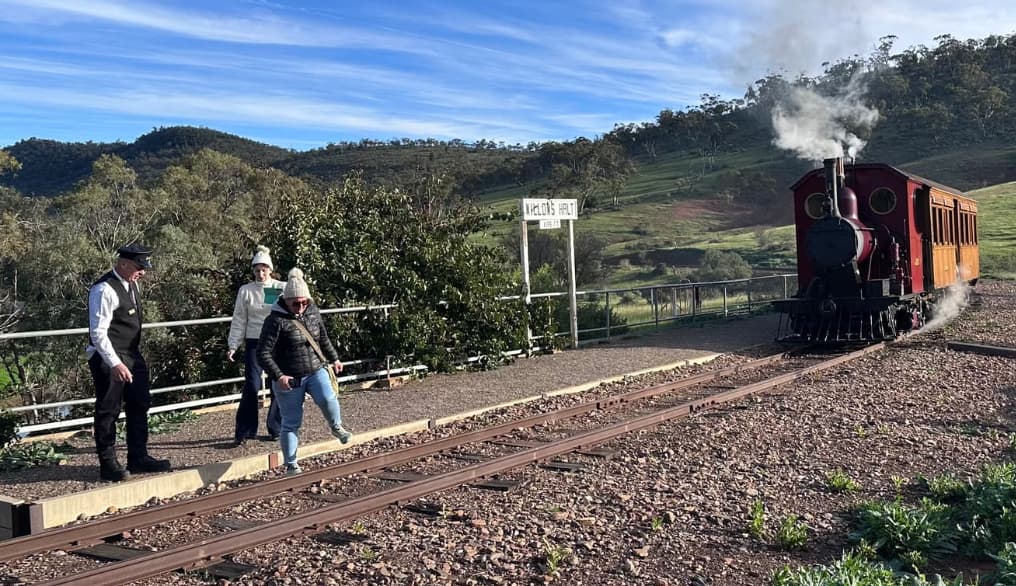
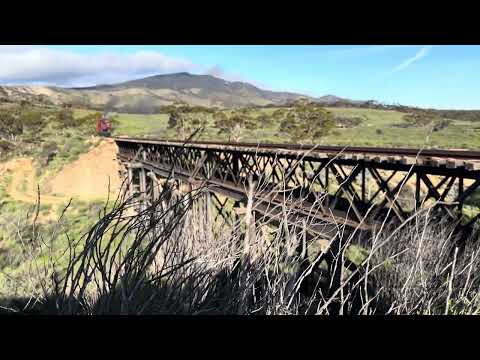
  • Flybys… We had three. In the middle of nowhere, we were invited to detrain, and the Coffee Pot would back up to the horizon, presenting movie and photo opportunities that would not be possible onboard.
  • Optional guided tour of the AG Williams Maintenance and Restoration Workshop upon return to Quorn. We had about two hours in the workshop, and we were invited to continue the ride on the train from the station into the workshop.

As you can tell, the Coffee Pot experience is designed as a premium event. The fare reflects that, as does the level of hospitality. The current fare is $320 AUD ($225 USD, £169 GBP, Gs1,387,878) per passenger. As you can see, depending on your exchange rate, you might expect to see a millionaire on board. @Korm :grinning:

A Journey Through Living Railway History

Perhaps the most remarkable thing about the Coffee Pot is not its age. Many preserved locomotives are older. It is that the vehicle is still performing the task on the same line for which it was designed more than a century ago.

…And much like the Galloping Goose in Colorado, the Coffee Pot proves that some of the most beloved railway vehicles are not the biggest or the fastest. They’re simply the ones with the most personality.

I’ll be posting some pictures soon.

Link to Pichi Richi Railway Site

6 Likes

Bill, that’s too cool! Sounds like you guys will maybe take the ride?

An Unexpected Journey

Getting tickets is difficult. A close friend of ours had purchased tickets way back in October 2025 on the first day of ticket sales. By the time he was able to log in, there were only 8 remaining seats. Unfortunately a couple of days before the trip he suddenly found he needed a +1, and gave me a call.

Located four hours from Adelaide, Quorn sits on the edge of two worlds. To the south are the settled farming districts of South Australia; to the north begins the vast semi-arid country of the Outback. Here, green paddocks gradually give way to saltbush, red earth, and the rugged hilly landscape of the Flinders Ranges.

The ranges rise from the plains in great folds of ancient sedimentary rock, their ridges glowing with shades of ochre, rust and grey. Through this challenging terrain, railway builders carved a narrow-gauge line by hand, blasting cuttings through rock, building embankments across creek beds, and threading rails through the hilly passes wherever the land would allow.

The Pichi Richi is a railway that works with the landscape rather than against it. As the train snakes through Pichi Richi Pass, every curve, cutting and stone embankment reveals the story of the determination required to push steel rails into a land where the pastoral south gives way to the Australian Outback.

Normally dry, red and dusty during much of the year, it’s been raining in the Flinders Ranges this winter and while the sky has been grey and dreary the landscape is now bright green with new growth. While the drive up had been slow due to heavy rains, the BOM had promised us clear skies for the excursion day. The morning remained grey and drizzly.

Once we found out where the Coffee Pot was being fired up we hoped to snap a photo or two before crowds of people surrounded it. Standing at the distant edge of the property, outside the fence, the fireman noticed us and sent the guard to ask us if we wanted to watch the prepping operation.
Yes, please!

Fun Facts

The small boiler means Coffee Pot can raise steam faster than a full-sized locomotive, but it still requires careful warming. The Coffee Pot is goes through a series of tests before every run at the workshop.

This takes 3-4 hours. Rainwater is preferred for filling the 220 gallon (1000 litre) tank.

As they did over a hundred years ago, the railway still obtains its coal from New South Wales as the local South Australian coal has a high sulphur content which would be quite corrosive to the locomotive. Approximately 840 pounds (380 kg) of coal is loaded for the trip.

During fire up everything is tested for the run. The working steam pressure is set to 170 psi.

This provides a tractive effort of approximately 2015 lbs (8.96kN)

The Whyte Notation classification designates the Coffee Pot as having a 2-2-OWT wheel arrangement.

  • 2 = one leading axle (two wheels) guiding the vehicle into curves.
  • 2 = one driving axle (two powered wheels) connected to the cylinders.
  • 0 = no trailing wheels.
  • WT = Well Tank, meaning the water tank is carried low in the frame between the wheels rather than in side tanks or a tender.

Once operating pressure is reached, there are a series of requirements:

  • Test whistle.
  • Test safety valves.
  • Test injectors under load.
  • Apply and release brakes.
  • Check regulator (throttle) operation and windup the reverser.
  • Ensure all gauges read correctly.

Our fireman for this trip lives near Adelaide (a 4 hour drive) and It’s going to be a long day, so it is easy to see why there is a Red Bull sitting on the toolbox. At the time of this photo it was about 8°.

Only two of these 19 ton 1 cwt (19.4 tonne) motor coaches were ever made. (1cwt = 112 pounds)

Finally a wipe down and polishing performed by the fireman before taking the motor coach for a short run in the yard.

Next, I’ll post some photos of the trip as time allows.

3 Likes

Great writeup and photos, Bill. Must have been a fun ride!

I think Shawn Viggiano made a model of it a few years ago?

Before Budd RDCs took over that fase of the passenger service, I think several light “steam carriage” models appeared from various manufacturers and countries. They all were interesting, but only a few were truly successful. I have a copy of the 1929 Mack Trucks railcar and locomotive catalogue with some interesting designs shown between its covers (the locomotives featured a gasoline engine and generator set for each axle - the number of engines started depended on the load to be pulled!).

Regards, David Meashey

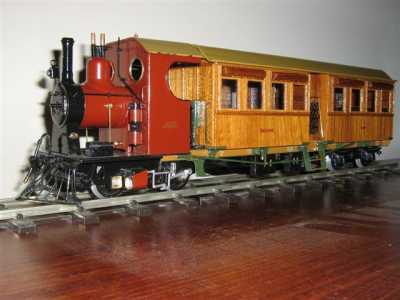
It is certainly a popular loco to model.

IMG_3101

Mark Horovitz did an ARTICLE on a large scale model in 2009.

1 Like

Wow, Horovitz ran that 'pot at a hundred miles an hour, who’d a thunk? :grinning_face_with_smiling_eyes:

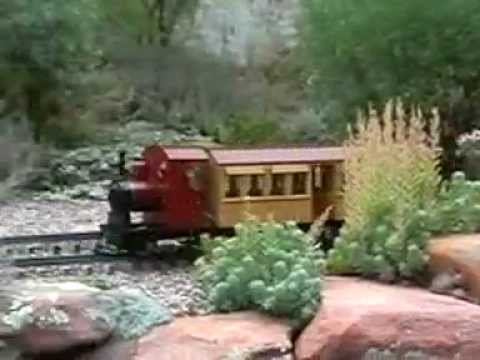
Nah yeah, thanks Bill, great video.

But did you ride the thing??

Ok Cliff here’s proof I was onboard. Yes. Yes, I did get to ride the Coffee Pot.

Here is my second class ticket.

On the return trip passengers swapped classes.

We had 3 photo opportunities to film the train from the outside.

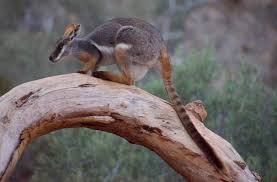
For those who made it this far, we saw the yellow footed rock wallabies and kangaroos, but from a distance.

IMG_3102

The local park had rock wallaby statues and historic chicken wire statues.

The town shows movies on its silo at night. Here are some examples of what we kinda, could have, seen had we not been watching the movie through rain hitting on the windscreen in between great wiper action.

2 Likes

Wow! That live steamer really scoots! I wonder what the run time is; probably close to my Accucraft Dora. I have managed to get 15 minutes from that little locomotive. The sensitive throttles on those little locomotives don’t allow much for a happy medium.


Beat, David Meashey

Dave,

What a beautiful machine!

So many questions…

  • Do you have an action shot of Dori?
  • Were the suspects in the Redford robbery found guilty?
  • Did the swimming club celebrate its hundred year anniversary?

Beautiful shots, Bill! Love that one with the Coffee Pot on the bridge. Neat interior pics!

This is a nice action shot:

A caption comes to mind, something like “Here’s where Aunt Martha’s wooden leg story starts.” :grinning_face_with_smiling_eyes:

Bill;
No actual video, but the photo below shows the locomotive running on the Ackinback Live Steamers’ short track at ECLSTS back when the show was in York, Pa.


Best, David Meashey

P.S. Not a clue for the answers to the other two questions. My swimming team days ended in 1967.