Get Your Motor Runnin
When it comes to adding scenery to the layout the most expedient is by far vehicles. Whether die-cast or plastic, models are readily available in almost every scale across the entire history of the automobile. Most model railroaders practice a very basic form of selective scenery compression in the absence of drivers and or passengers. Just place the vehicles on the roads of the layout and let the observers add the people in their minds. Unfortunately this practice does not hold up very well for motorcycles. A riderless bike defying gravity is too much for the imagination to compensate for.
You could choose to forgo placing motorcycles on the layout except as parked models but that would ignore the fact that motorcycles outnumbered cars in the US until the latter part of 1910 when Henry Ford’s 1908 “Tin Lizzy” model T finally made the car affordable for the general populace. It seemed that every bicycle shop in the nation had fabricated a motorized version of the common pedal bike but only two brands would survive the Great Depression, Harley Davidson and Indian, with the rest going down in the first few months owing to a small market share and lack of operating capitol.
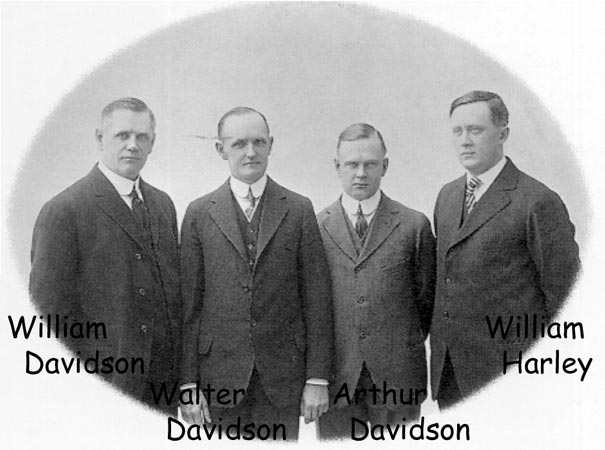
The creators of an American legend.
Indian Motorcycles made it past World War two before finally going bankrupt in 1953 but Harley Davidson endures to the present. Lucky for us model railroaders their motorcycles are well represented and readily available. If you want motorcycles on your layout then HD is your best option.
The effort to build a powered bicycle began in 1901 in a tool shed behind the home of Henry Melk, a longtime friend of Arthur Davidson. The next summer they were joined by Arthur’s brothers, Walter and William. Like most early motorcycle builders the HD brand was an attempt to bolt a small combustion engine into a pedal-bicycle frame. The motor, designed by William Harley, boasted a meager 7.07 cubic inches of displacement. It was severely undersized and failed to produce reliable horsepower but did provide the friends with valuable experience.
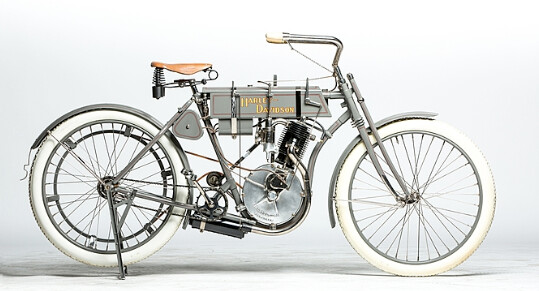
The original HD. One was built in 1903 and a second in 1904.
The group’s next offering was a new single cylinder engine designed with help from Ole Evinrude (of outboard motor fame) and made available as a do it yourself kit for converting bicycles. It was well received and within a year HD was building and selling complete bikes. Financial success arrived in 1907 when HD introduced the first V-twin two cylinder engine attached to a beefed up new frame that could withstand the rough roads of the time. Their first large orders came from police departments who saw the motorcycle as an inexpensive and reliable form of mounting their officers. Harley continued to design bikes for law enforcement for the next 80 years.
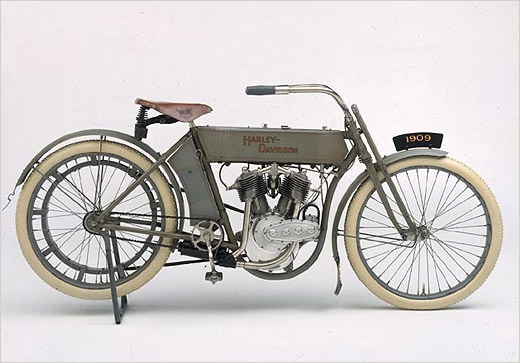
1909 Model 5 V-twin, the first HD production motorcycle. It had the unique claim to fame of having spare parts available from the factory for repairs.
Harley Davidson made many improvements to the frames and features of their motorcycles over the first three decades of its existence but engines were what built the brand. In 1911 the company introduced the F head. This engine would be the mainstay through World War one until 1929 when it was phased out by the flat-head. This 45 cubic inch V-twin design would prove so reliable that variations of it would continue in production into the early 1970s. Joining the line in 1936 a 61 cubic inch engine was introduced and dubbed the knuckle-head in reference to the rocker boxes on the cylinder tops.
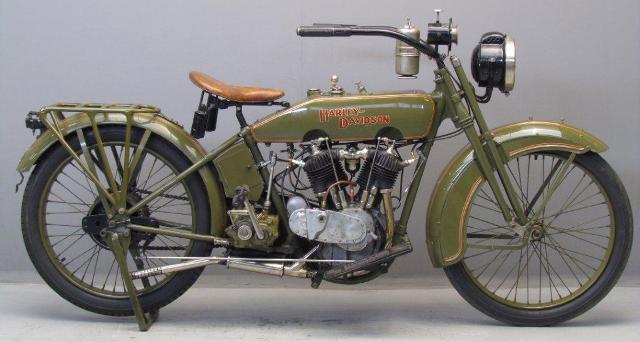
1917 Model 17T featuring the F head engine. This was the first motorcycle adopted by the US Army.
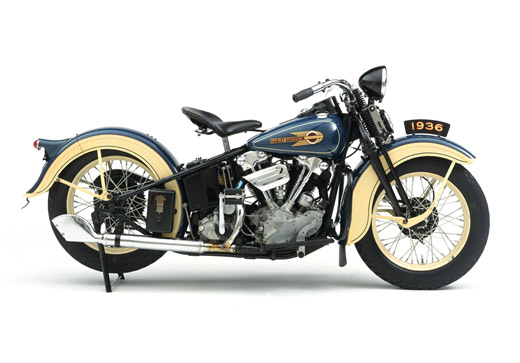
1936 Model EL featuring the knuckle-head engine.
Military need in World War Two sucked up all of HD’s production in the form of the model WLA. The designation reflected Army specifications which favored the smaller and more reliable flathead engine which could operate on poor quality fuel as low as 73 octane.
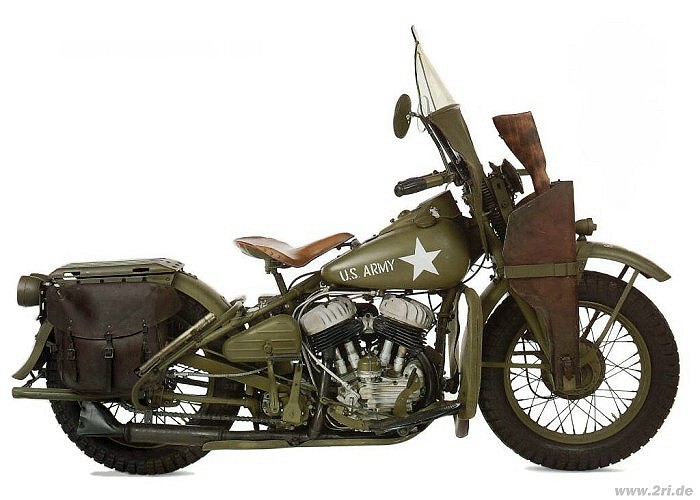

Top: 1942 WLA. The bike was used extensively by armored units for scouting and messenger service.
Bottom: Army scout riders in training circa 1943. Still missing most of their combat accessories riders like these were trained in many of the skills that would be common in motor-cross racing during the 1960s and 70s as well as road hazard avoidance techniques taught in modern riding classes.
Manufacturing over 90,000 of the motorcycles during the war there was no production capability left on the factory floor for civilian bikes. Fate had intervened on engine design so while the flathead went to combat the knuckle-head went on life support before dying an early death in 1947. The following year HD introduced the pan-head as its top of the line engine. It lasted only slightly longer than its predecessor before being replaced in 1965 by the shovel-head engine ushering in the modern big twin era.
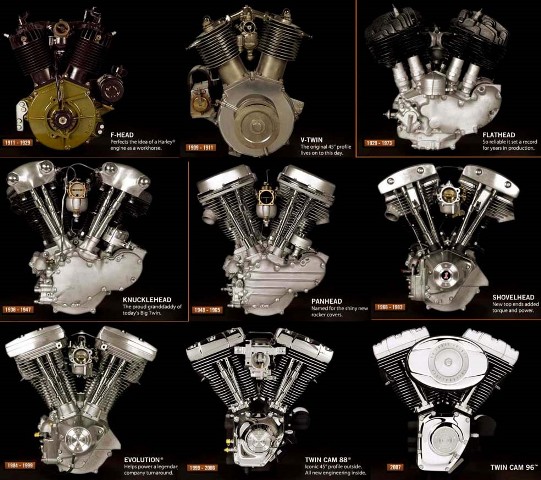
The Harley Davidson legacy of engine design. The distinctive V-twin has been copied around the world.
Developing alongside of motorcycle technology was the riding culture. Early interest in bikes was as a novelty but as reliability increased so did the population of the riding public. Harley Davidson had jumped into the motor sport scene with both feet for both the promotion and the development opportunities. Company sponsored teams competed on, board and flat tracks, hill climbs and endurance races. Young men and women soon wanted a taste of the excitement. Riding clubs sprang up all over the East coast and throughout the Midwest. As America’s love affair with motor vehicles grew recreational riding quickly caught up to recreational driving. By the 1930s riders were regularly traveling cross country from coast to coast. A common site in any small town could be dusty riders alone or in groups out to see the country.
Sales boomed in the 1920s but it was not all leisure riding. Police departments, delivery companies and the military all used motorcycles or their three wheeled cousins the servi- car. A common site on many a lonely highway was the State Police Officer on his bike. In 1933 New Mexico’s motor patrol (forerunner of the State Police) began with 10 officers mounted on Harley Davidson motorcycles. Their job was primarily enforcement of traffic law on the highways.
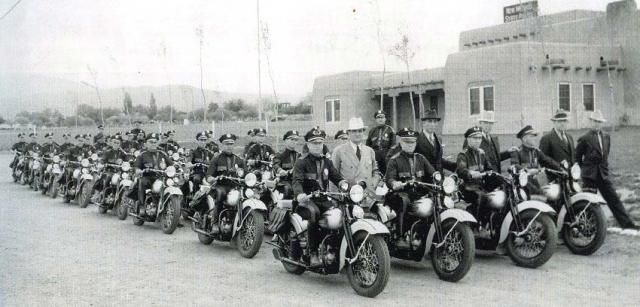
New Mexico Motor Patrol Cadets.
Regardless of why they were on a motorcycle early riders soon found a need for some protection from road hazards such as grit, rocks, bugs and the occasional low flying bird. In the 1910’s riders borrowed clothing from the automobile enthusiasts, long coats, driving glasses and gloves were common gear along with sweaters and driving caps. Post World War 1 riders quickly adopted surplus pilot garb including leather gauntlets and flyers caps. As bikes became heavier and more powerful leather equestrian coats and pants became popular. The most iconic look of all was the black leather coat as worn by Marlon Brando in “The Wild One”. Styled after the army uniform “Ike” jacket this apparel was not available until post World War Two when HD introduced it in 1947.
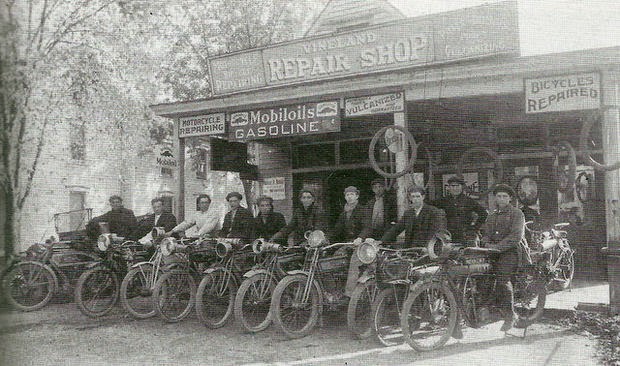
1915 an early group of riding enthusiasts shows off their “Hogs”.
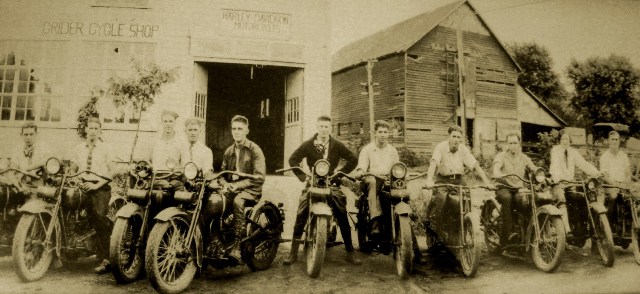
1920 with the weight and speed of motorcycles increasing, clothing choices became heavier and stronger to protect riders.
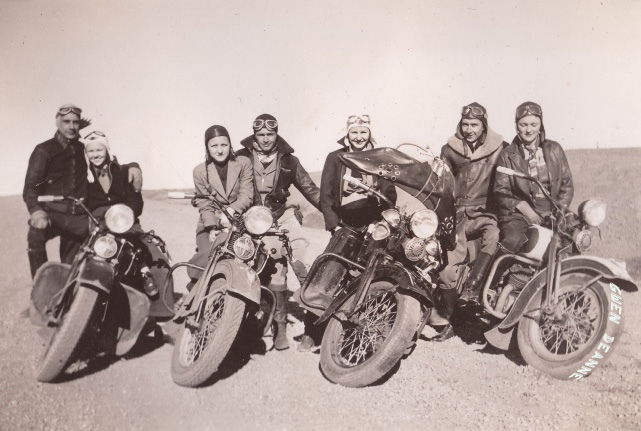
1930 with the end of World War One a surplus of high quality pilot apparel drives another change in riding gear.

Marlon Brandon answers the question of “What are you rebelling against Johnny?” with “Whaddaya got?”
Head Out On the Highway
Those of you using 1/24th or 1/32nd will find a large selection of figures and bikes available. Since I am working in 1/20.3 scale I have to settle for 1/20th details. I have only been able to find one motorcycle model suitable for the 1930s. It is made by Matchbox and is a passable version of the single seat 1937 knuckle-head. These come two to a package so I decided to model one figure riding and one figure standing with the bike parked nearby
Figure 1
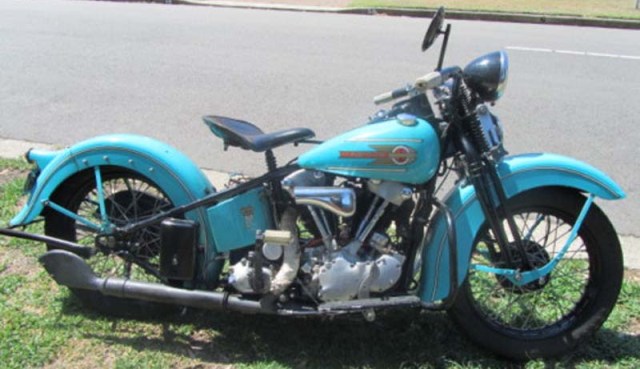

A cherry 1937 knuckle-head in turquoise blue. This is the bike I based my project on.
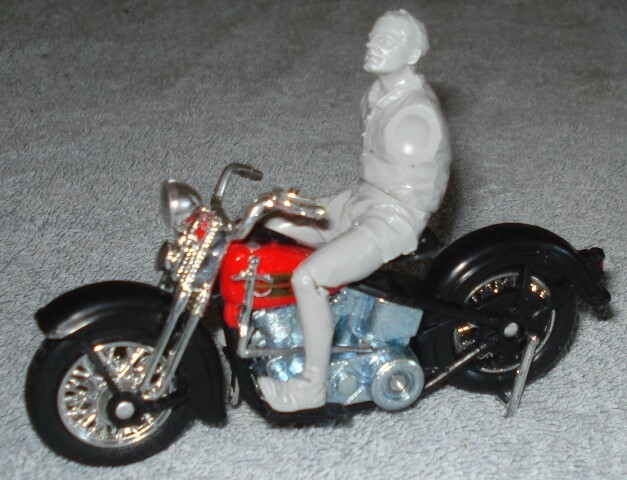

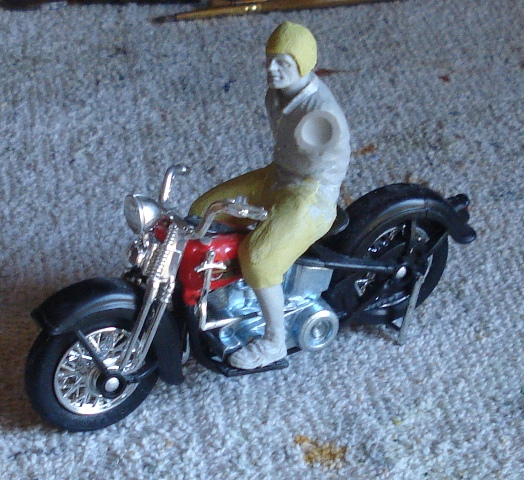
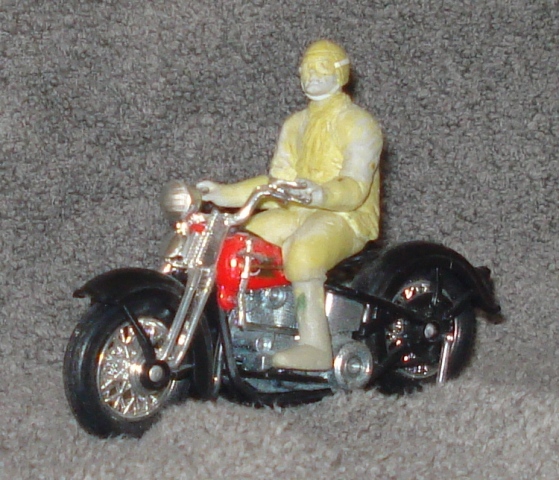

The rider body, made from a Tamiya pit crew figure, is fitted to the seat and handlebars of the Matchbox motorcycle.
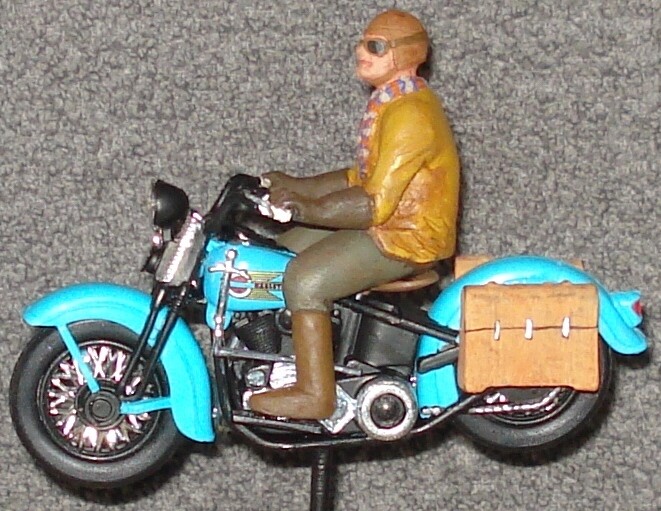
It is 1938 on the Cibola Railroad. Route 66 is still a dirt road across the desert running from Chicago to Los Angeles as this rider, decked out in period garb, is ready for a warm bath and a cold beer in the town of Broken Wheel.
Figure 2
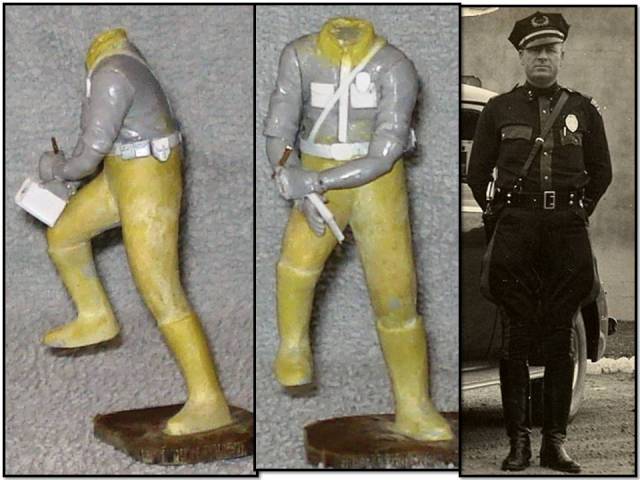
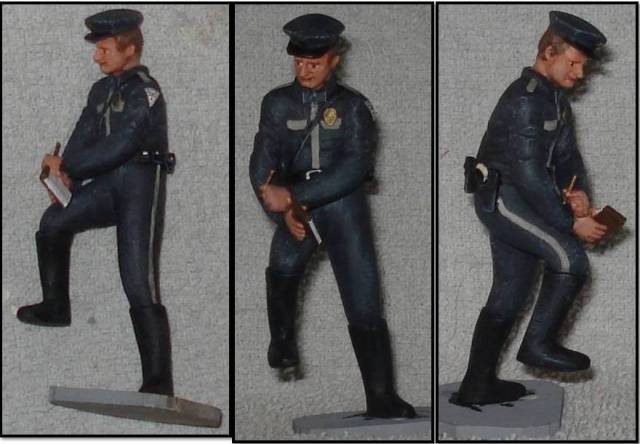
New Mexico Motor Patrol Trooper circa 1930
Paper, styrene and model bits used for the details made this my most complicated figure so far. The Motor Patrol became the New Mexico State Police in 1935. The uniform has remained virtually unchanged in appearance with the distinctive black and grey still used today.

“Okay pal, where’s the fire?” One of New Mexico’s finest, stops a speeder outside of Albuquerque in the late 1930’s. Many a rancher got their first look at a V-twin while being issued a citation for speeding.
Have not done the police bike yet but I will get to it soon.


