Large Scale Central

Diorama terrain surface

Over the next few years, I hope to build a series of dioramas for the Sutro Tunnel museum in NV. Each will be in F scale, and feature different rolling stock of the Sutro Tunnel Railway, in a unique scene. All will be indoors, but in a building that’s not climate-controlled. Each diorama will be contained like a shadowbox, with a protective window, and be internally lit.

At the moment, I’m trying to nail down approaches for various features, such as terrain (which, in this tunnel, can be on walls and ceiling as well as floor). The basic shape of the environment will be made of EPS foam sheet, glued together, and roughed up. At least for now. For example:

Inboard of the EPS there will be a margin, approx 1/4" thick minimum, for the terrain surface material (shown darker). That will be applied after wooden features such as ties get installed.

I’m counting on the clay-filler to vary the terrain-surface and make it believable. But it’s gotta stick forever to the EPS foam. And not shrink & crack badly. BTW I’ll add texturing materials over this substrate.

But now comes materials cost, because we’re on a tight budget. I trust epoxy clay, since I made a hill of it for an outdoor mine several years back, with a surface about 3/8" thick, and it’s never cracked or degraded. But it costs about $9.5-$14.5 per pound.

The cheap alternative is air-dry clay, such as from Crayola, which is about $2.5 / lb, or DAS, at about $6.50 / lb. Or Activa at $3.7.

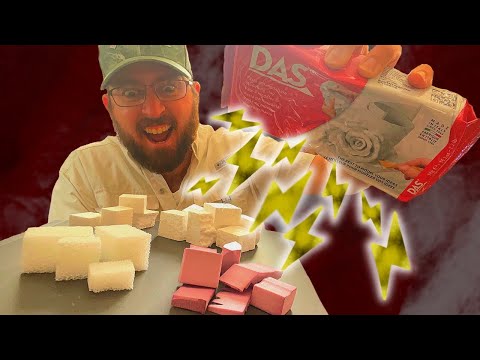
I ran across this video on air-dry clay adherence to different types of foam (using DAS), and it was very informative. Seems that roughing the foam up is critical for adhesion. Medium-density EPS seems to do ok.
But, I’ve read that the Crayola air-dry foam can shrink like 10% or more, so that doesn’t sound good. Not sure about the DAS or Activa clay.

Either way, I’m a bit concerned about the ceiling, and may glue & stab some dowels into the EPS above for the terrain material to grab onto.

I’m leaning toward the epoxy clay, but has anyone used the air-dry? If so, what brand, and does it shrink badly? I plan on doing a test between the two on the diorama shown, air-dry on the left, epoxy clay on the right. I’ll use Activa for the air-dry, since it says it has minimal shrinkage, and Smalltongue for epoxy, since I have some on hand.

We’ll see what happens.

Suggestions welcome,
Cliff

1 Like

Check out WoodEpox [ https://www.homedepot.com/p/WoodEpox-12-Oz-clear-WEAB60R/325841456?MERCH=REC- ]

I first used it a month ago doing wood replacement on an EBT combine. It sounds similar to the epoxy clay you refer to. $13 for two 6oz tubs of both parts.

It mixes by kneading and has a very long working time. Once set it can be carved or sanded. Fully water proof. I’ve had a ball of it soaking in water for a month and it has absorbed none.

1 Like

stick forever? yes, it does. (if forever = 12 plus years)

shrink and crack? yes it does. the pic shows crackfiller upon icecreme box, about 1/4" thick after the first application:

and after some sanding and crackfilling:

1 Like

What about getting a local business to sponsor the exhibits?

Could also try seeing if the makers of your favorite epoxy clay would be willing to do a donation, or even heavily discount a large order, in exchange for a nice plaque (“This model sponsored by the Clay Company”). Maybe the clay company would like some nice pictures to put on their website as examples of what you can do with their materials in exchange.

1 Like

Benjamin, that’s great advice. I do attempt here and there to see if donation is of interest, but am not consistent, so thanks for the reminder.

Korm, thanks for the confirmation that the stuff sticks and lasts. And since I’m representing rough rock surfaces, cracks in the wall and ceiling might be a bonus.

Jon, good idea. Funny that the 64 oz price is a few cents cheaper than the 32, but maybe that’s a typo. Also, you make me wonder if something like cheap stainable wood filler or dough would work just as well. So I’ll test that as well.

I used Magic Sculpt for my yard office. It’s an acrylic box with the Magic Sculpt stuck to it. It’s at least 15 years old and still in great shape.

Thanks Bob, yeah that’s great stuff. I have full confidence in that product.

The plan is gradually taking shape. Whatever the terrain material is, it should also be used on the cutaway rock face at the front. So I moved the EPS face back.

The foam will get roughed up wherever the clay/etc. goes. And I’ll add a hidden cross-member inside the box to hold up the foam.

thinking twice, there is another possibility - use just foam and acrylic paint.
(given, that mines are not chiseled, but blasted)

easy to make.

just insert different thickness of foam or styropor into each other.

and then pass over it with a hot soldering iron. then give a pinch of sand into acryl color for a rough surface. or, if you are as lazy as i am, just hold a rattle can in the general direction.

1 Like

All fine ideas, Korm. Your tunnel looks awesome, it really reminds me of the CP’s Summit Tunnel over Donner Pass.

My situation is a bit different though. Only a couple of the dioramas will have the exposed rock, but all will need the cutaway rock face treatment (facing the viewer). The interior hard rock mine surfaces will need to be rigid, to install drills, candle holders, etc.; the model face will see abuse from me handling it. So both will need the firm surface material.

But you bet, I’ll be mixing sand & etc. into the paint that covers the surface material, or applying it with mod podge.

That reminds me of when I was the painter’s helper at Hershey Park. We would mix sand into the paint for the funhouse walkways (for better footing traction).

Best, David Meashey

or you make your own cement paint.
distribute pure cement (without sand) on some plastic foil about 1/8 " thick, wet it, let it dry and then break it up with a roling pin or hammer. mix with the same amount of fresh cement and some water and you get surfaces, like these:

the cement paint in the pics was applied on chickenwire, covered in double layer toiletpaper.

1 Like

Looks excellent, Korm thanks!

Testing is moving along. I’m comparing (top left, going clockwise) a couple new products and some I had on hand, with aprox prices by the cubic inch:

Red Devil Onetime spackle ($.12)
Minwax wood filler ($.43)
EpoxySculpt clay ($.31)
Craftsmart Air Dry Clay ($.34)
Activa FastMache ($.18)

It’s mostly all wet, so tomorrow I hope to test for adhesion and durability.

As far as workability goes, the FastMache is far better than the others. I just got off the phone with an Activa rep, and she says that a sister product, Celluclay, is better if I have a 24 hours of curing time (which I do). It shrinks less and is cheaper. So I need to get a little of that as well.

Here’s the diorama box: & filler…

… with a bit of reinforcement:

The reason for the voids is that subsequent models take up a lot more space then this model of the initial header tunnel. This will be diorama #1 of (Lord willing) 12, progressively showing the Sutro Tunnel and its railway equipment over time.

Wow! You could have used all of the train boxes that Rooster threw out.

Just had a thought about locking the surface material to the foam (in case adhesion seems iffy): gobs of short drywall screws, with heads protruding about 1/8", with the material encasing the heads.

Cliff I have built numerous terrain pieces for war-gaming out of foam insulation board covered in latex paint and then sprinkled with sand. Once it is dry you can airbrush in rock color tones. This is very strong.

If you feel it must be covered with some smoothing material I suggest Durhams Rock Hard Water Putty. Affordable, water clean up and hell for stout. Takes paint and glue very well and can be carved for relief effects.

3 Likes

Hey Boomer good to hear from you.

Thanks for your insights. Like you, I’m using the foam board as a substrate. For more than one reason, I have to add the surface texture material.

That Durham water putty has been nagging at my brain here and there for some time, never tried it. It’s at my local hardware store. So now it’s on the list, thanks.

(for my eyes) the two on he right side look like washed out stones in a river.
the upper left, like a disturbed sand-beach.
the lower left comes nearer, than the other samples. (but i would still miss the rough surface of broken stone… )

ps: i know, you can do much better

pps: having in mind, that you will build for a museum - go the hard way.
make thick plaster walls and chisel the surface with a small flat screwdriver.

I agree. And it’s far more workable than the others. And I think the broken rock surface can be achieved better with this, whether by stippling only (as in the test), or tearing out bits.

This is the only photo I know of for this particular header tunnel, very rough.

So far, only the lower left (paper mache) allows easy building up & blending of material. It’s lightweight, and can be bought in bulk.

But I’ll try 3 more today or tomorrow: Durham water putty, air drying clay and the slower-drying paper mache (which is supposed to shrink less).