Large Scale Central

Dead spot within Rail

Hey guys.

I’m working on my modules for Big Green, trying to make sure everything is going to be operational for the show in January. Yeaterday I was testing the track power and found that the branch line has a dead spot within a single continuous section of rail. I used my dad’s Stainz for testing along with my multimeter. The engine kept stopping or stuttering at the same exact point while I had the power connected at one end of the track. (See photo for where it stopped. note the space in the rail direct to left of the wheels.) Then, when I mlved the power source to the other end, the loco would stop over the rail gap.
Power is maintained through the entire branch line, per my multimeter, but does seem to drop at this one 4" section (out of a 2’ solid piece of brass).
I cleaned the rsil head like crazy. So I’m not sure if that could still be the issue.

Any thoughts are appreciated!

solder a strip of brass Shim stock to the rail top to span the 4" section, or cut out the bad and replace.
Edited to say shim stock not .032

i would bet, it is the connector (fishplate).

try to take a short piece of wire (any wire, even solder wire works) and push it between the rails and the plasticbands under the rails, on both sides of the gap.
then use your multimeter again.

I found that that was the perfect place to put a rail clamp.

1 Like

Did you mean 4’ or 4" section?

I’m not following the exact question. So this is “my answer” without further understanding?

If it is only ONE spot on a 4’ section then my guess is it’s that spot that needs cleaned more. Now if it’s a whole 4’ section that is loosing power or voltage drop then it’s in the connection.

squeeze the joiner with a pair of pliers. See if that helps.

If you have a dead spot in a circle of track it means that you have 2 bad joiners. When that happens on my RR I leave the power on and use a screwdriver to bridge the gap in the rail. If the engine starts I found the bum spot and it gets cleaned, or a rail clamp goes on or if I’m too busy running trains a squirt of 2-26 will get the power flowing again for a time.

I do have a section of 3’ LGB track that has a dead spot in the track. I can clean the top of the rail and the train will still slow over that spot or even stop if it has a short wheelbase. There is something in the track that is not good.

i agree.
but my tip was for those, who have no rail clamp at hand.

Just switch out that section of track

John, you’ve probably solved this already, but if not…

How about a simple test with a length of wire, connected to the wire feeding the problem rail. With your loco in the dead spot, you’d touch the free end of the test wire along the problem rail. That way, when the loco starts moving, you’ll be able to narrow down the point of issue – likely a joiner.

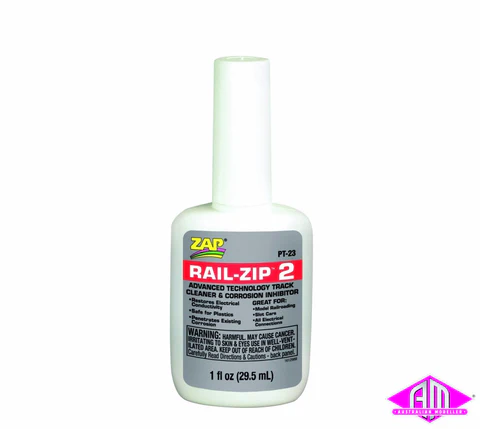
Has anyone tried Zap’s Rail-Zip?

IMG_2150

Yes…and it does work but will cause wheel slip so the way I see it is WD40 in a drip bottle.

This it’s my issue. A short section of track, which is currently glued down, is being problematic. Any thoughts on why it happens, Todd?

Sean is problem right and I should replace the section, but I am hoping to avoid that, as it would mean re-laying a section of track; which I don’t really have time for.

for an ugly and quick temporal fix - cut two pieces/strips of alu foil (of the type you use to put a pizza in the oven) crimp them over the rails and glue to the sleepers/ties. (not to the rails!! )

… and tell us, for how many rounds it stayed in place…

alufoil worked in my agricultural tractors to replace fuses - so it should be good for this too.

This is EXACTLY why I asked what I asked. However the consensus is rail joiners so I walked away.

This is the stuff to use:

I think there could be something in the track like junk from the manufacturing process. They always said that LGB was virgin brass. I had this happen twice. In one spot I replaced the track and in another I have been dealing with it. It takes extra cleaning and short wheel based locos still stall out on it.

I think if the jumpers don’t work you will have to replace it. If you can figure out which rail is the issue maybe you could replace just that rail without having to unglue the ties?

I know exactly what piece it is. This is a good idea that I hadn’t considered.

I actually made a quick video, which shows the problem. I had two issues on my modules: the first was that the mainline wasn’t getting power all the way through. I needed a jumper wire to the middle section, which was dead for some reason. Then, the branch has continuous power, but this short section is an issue. At about 0:25 in the video is where the problem starts. I did get the Stainz (borrowed my dad’s) to run over the section a few times, as shown, and I think longer wheelbase locos will be okay. But, as @capecodtodd says, the short locos, like a Stainz, will have issues. And, I’m almost positive that everyone who runs track power does so with short locos (Stainz, speeders, etc). I am just now realizing (as I type this) that I managed to not include the close-up shot I took of the problem-rail in my video. But, it is the same section that the level crossing touches. So, replacing it would be… challenging. Still, it’s probably my best bet.
https://youtube.com/shorts/T2IjlaRvf9c?feature=share

1 Like

John;

I feel your pain. The model below is especially sensitive to dead spots.

Hope you can solve it, David Meashey

I just watched your video and have a few ideas that echo what others have written.
When the engine stops use a screwdriver and touch it to the gap at the rail joiner one at a time. If the engine moves again the joiner is the problem.
Your track looks clean so pickup shouldn’t be a problem but have you checked the wheels and slides? Those could be dirty. Also you should not be using sandpaper on your track. It can create scratches where dirt/oxidation can settle. Your setup is inside so you might be okay but if I were you I would switch to rubbing alcohol, goo gone but it is slippery, or even just a damp rag on a pole sander.

If the problem persists you could build an auxiliary power pickup car. I built a few tenders for my LGB Porters and a calf for my Mighty Moe to spread the pickup wheels.

2 Likes