Large Scale Central

Bachmann Spectrum 2-6-0 not running

Ok… I figured it out! My mistake. All is working and I replaced the broken gear myself with the Bachmann replacement gear and axel. Pretty proud of myself (https://www.largescalecentral.com/externals/tinymce/plugins/emoticons/img/smiley-cool.gif)

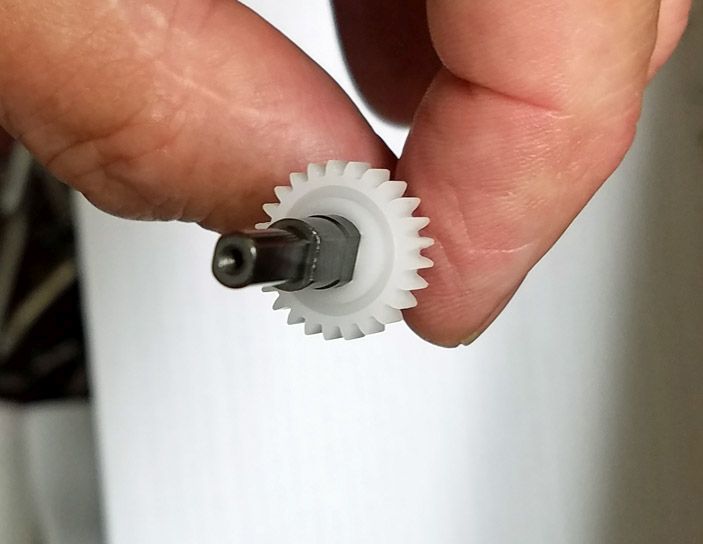
With that said, I also have the NWSL gears that I purchased for the same project on my other 3 Bachmann 2-6-0 that also have the split gear. However, for the life of me I can’t figure out how to get the gears on the axel. I can only get them on this far. What’s the trick?

If the NWSL gear is metal. You can Heat it to expand and then let it cool to shrink.

Jason

Jason V. said:

If the NWSL gear is metal. You can Heat it to expand and then let it cool to shrink.

Jason

It’s not metal.

A couple ideas come to mind and have worked for me over the years for pushing gears and such on to shafts. All utilize small appropriately sized sockets from a ratchet set. I like method TWO the best, but all work with a little common sense and care. I’ve use an arbor press to change bearings/gears/spacers and similar ilk for years. Sometimes sockets work other times plate(s) with hole in the middle supported with spacer blocks, simply depends on what you have in hand.

Place the gear on-top of the right diameter socket, insert the axle and push/tap the axle threw the gear.

  1. Place a shallow or deep socket (depends on the need) on the work bench, with a small hammer tap the shaft down onto serrated shaft area.

  2. Small Arbor press from Harbor Freight Tools or other sources. Again using a socket(s).

  3. Benchtop vice, again utilizing small sockets.

Michael

I also have the NWSL gears that I purchased for the same project on my other 3 Bachmann 2-6-0 that also have the split gear. However, for the life of me I can’t figure out how to get the gears on the axel. I can only get them on this far. What’s the trick?

Timmy, that’s not the right gear for that axle. Maybe NWSL sent you the wrong one? Measure the axle diameter over the smooth bit next to the ridges and email them. Maybe even send them the original split gear?

You have a “shouldered” axle which widens where the valve gear slides on. I am assuming that the gear is clearly not going to slide any further past the shoulder?

The NWSL gear is delrin, a type of hard plastic. The “trick” is going to be drilling it out to the right size. For this you really need a vertical drill press. (I bought one for drilling maple cabinet drawer fronts at Home Depot for $90. Many years ago - your mileage may vary.) Or find a friend with a machine shop - a lathe is the proper tool for this job.

If you have a micrometer it will be easy to measure the shaft diameter, but it is probably metric and something like 4mm. Your local Ace hardware will sell you a Xmm drill, or you can buy one online. (If you don’t have a micrometer, now would be a good time to buy one!)

In any case, the trick is to drill a test piece - not the actual gear. Find a drill bit that you think will work and use it to drill a hole in something like a hardwood strip or piece of plastic. Then test that the piece is a tight fit on the axle all the way up to the ridges. Keep trying until it is a close fit. Don’t use an oversize drill thinking the ridges will hold it - if you can’t find something exact, then drill it slightly small and see trick 2.

The gear will have to be held very securely - I use soft wood on either side in a vise or clamp and let the wood grip the gear teeth. You will have to drill very slowly and carefully - don’t press down too hard. It’s quite difficult to drill out a hole in plastic that is almost the right size in the first place, so be careful and make sure the gear is centered under the drill. (To help center it, you can load a smaller drill that fits the existing hole and, with the drill off, press it into the gear while you tighten the clamp to hold it in place.).

If you have drilled out your gear and it is still a bit too tight, then put a round file smaller than the hole in the drill (trick 2) and use it to carefully file (ream) the hole slightly larger. [A proper size drill is a better option! A reamer is the proper tool for opening a hole slightly, but I don’t have one and I doubt you could find one.]

What you are aiming for is a good fit on the smooth shaft and for the gear not to wobble too much when you spin the axle in your fingers. Then you can gently tap the axle into the gear - Michael’s suggestion of small sockets to support the gear while you tap is a good one. I use the vise and put the axle loosely in the jaws so I can tap it through the gear.
Yup… I just realized NWSL sent me the wrong gears.

I ordered 2223-6 which it clearly shows on my sales receipt. But they sent me 2236-6 which are way to big. I’ve sent NWSL an email asking them to send the correct gears.

timmyd DeHan said:

Yup… I just realized NWSL sent me the wrong gears.

I ordered 2223-6 which it clearly shows on my sales receipt. But they sent me 2236-6 which are way to big. I’ve sent NWSL an email asking them to send the correct gears.

In that case, forget everything I wrote after the first paragraph (http://largescalecentral.com/externals/tinymce/plugins/emoticons/img/smiley-cool.gif)That gear won’t fit even if you do get it on the axle.

When I use a vise and socket to install a gear on an axle, I also place a thick steel washer at the gear so as to push the whole gear evenly as a socket may be offside a little and 'bend/misshape" the gear.

I’ve contacted NWSL to show they sent me the wrong gears. In the meantime I’ve successfully replaced the gears in 3 of my Bachmann loco with the Bachmann replacement gears. Which by the way look EXACTLY like the ones that split that I am replacing. Odd.

Anyway, I’ve run into another problem. Two of the 2-6-0 locos run just fine after the gear replacement but one of my 4-4-0s does not. This seems odd to me. With the rods off the wheels the drive wheels spin just fine when power is applied. However, when I put the rods on the wheels nothing happens when I apply power. It’s like something is getting shorted out? Here’s a short video showing the issue. Any suggestions?

Which by the way look EXACTLY like the ones that split that I am replacing. Odd.

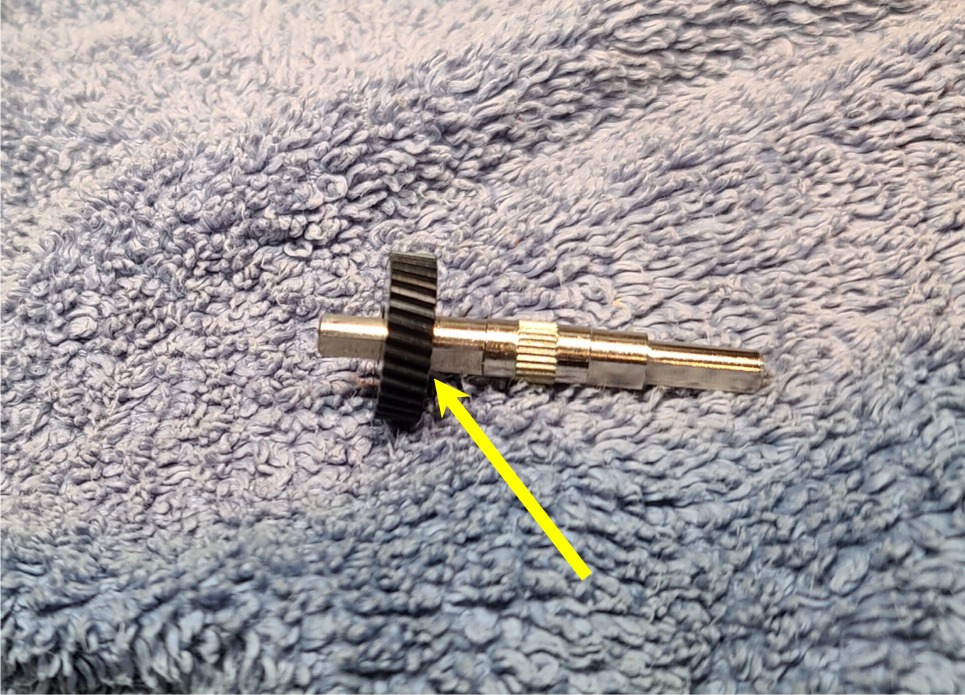
Not quite. The new ones have a “D” profile to stop the gear spinning. You can see it clearly on your pic - center axle of the three. Compare that to the photo of your axle with the NWSL gear.

When we discussed this on my old thread, the question (which has not been answered yet,) is whether the plastic is the same, or if the new gear will split and not spin (http://www.largescalecentral.com/externals/tinymce/plugins/emoticons/img/smiley-sealed.gif)

With the rods off the wheels the drive wheels spin just fine when power is applied. However, when I put the rods on the wheels nothing happens when I apply power. It’s like something is getting shorted out?

Yes, it does look like a short - but you can check that with a multimeter across the wheels set to ohms? Doesn’t your power supply detect the short and turn itself off?

It doesn’t look as if the rod and cylinder piston is running free on your video. I assume it is, and that’s just a video glitch. The main valve gear is live, if I remember correctly (my 4-4-0 loco is 1200 miles away.) The metal wheel passes power through the stub axle in the frame bearing, so the metal rods are live. Once you get your multimeter organized, you should be able to test the various bits of valve gear. The inside stuff is not live - both sides are on the axle and therefore they are connected - if you put one of them back in wrong you may have made it touch something it shouldn’t?

Pete Thornton said:

Which by the way look EXACTLY like the ones that split that I am replacing. Odd.

Not quite. The new ones have a “D” profile to stop the gear spinning. You can see it clearly on your pic - center axle of the three. Compare that to the photo of your axle with the NWSL gear.

When we discussed this on my old thread, the question (which has not been answered yet,) is whether the plastic is the same, or if the new gear will split and not spin (http://www.largescalecentral.com/externals/tinymce/plugins/emoticons/img/smiley-sealed.gif)

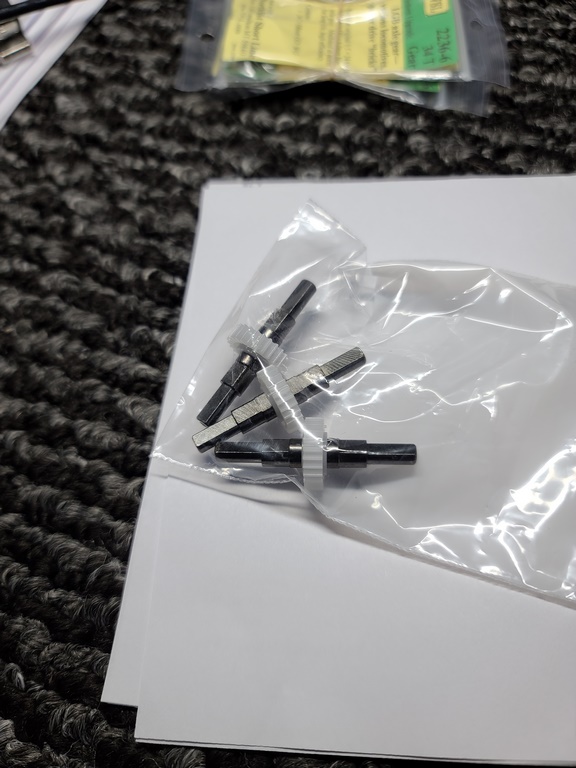
I guess I don’t understand what is meant by a “D” profile. The new ones from Bachmann look to me to be the same as the ones I removed. Here is a pic of the axels I removed.

Pete Thornton said:

With the rods off the wheels the drive wheels spin just fine when power is applied. However, when I put the rods on the wheels nothing happens when I apply power. It’s like something is getting shorted out?

Yes, it does look like a short - but you can check that with a multimeter across the wheels set to ohms? Doesn’t your power supply detect the short and turn itself off?

It doesn’t look as if the rod and cylinder piston is running free on your video. I assume it is, and that’s just a video glitch. The main valve gear is live, if I remember correctly (my 4-4-0 loco is 1200 miles away.) The metal wheel passes power through the stub axle in the frame bearing, so the metal rods are live. Once you get your multimeter organized, you should be able to test the various bits of valve gear. The inside stuff is not live - both sides are on the axle and therefore they are connected - if you put one of them back in wrong you may have made it touch something it shouldn’t?

No idea whether the LGB 50081 power supply turns itself off if it detects a short.

I have a multimeter but don’t know the ins and outs of it. What exactly do I need to set it to and what am I looking for?

Not sure what I would have put back in wrong. With the wheels off or on and or the rods not on the axel spins as expected when power is applied. When I place the rods on I get nothing. No spin, no noise, nothing.

So, this seems weird to me. Here is another video showing the issue with the rod on and off. What’s seems even stranger to me is that if I touch both the left wheels with power the drive wheel turns. Seems like this should not work?

I figured it out and solved the issue. My bad! I had these (whatever they are called) switched to the wrong side when I put everything back together.

Only one item left to wrap up this loco. When taking things apart these 2 very tiny springs fell out from someplace. Any idea as to where these go?

Those Springs are to be inserted between the “Bearing Blocks” shown in that previous picture, and the frame. They are what gives the “Spring action” on each axle…

This whole “Fiasco” you have been going through proves that it pays to take great care when dis-assembling a well built locomotive, or for that mater; any piece of equipment.

My complements on your getting through it so well.

Fred Mills

PS; you can see the small hole on the top end of the bearing block, in the picture. Insert one spring in it when putting the bearing block into the frame. There should be a spring in every bearing block…

I guess I don’t understand what is meant by a “D” profile. The new ones from Bachmann look to me to be the same as the ones I removed. Here is a pic of the axels I removed.

The “D” means there is a flat part (hence “D” instead of “O”.) On your original axles, you have a flat part both ends of the axle to take the valve gear. The new one from Bachmann has a flat on one side that continues all the way through the gear to the other side. So if you took the gear off the new axle and looked at it from the side, you’d see a “D” shaped hole. Here’s the pic of the one I got for my 4-4-0, which clearly shows the “D” shaped hole.

Now we’ve cleared that up, on to the short circuit. . .

I had these (whatever they are called) switched to the wrong side when I put everything back together.

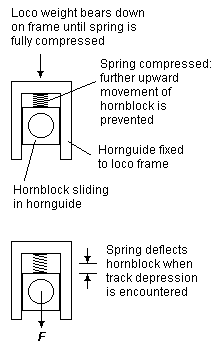
They are called bearing blocks, or hornblocks. They slide up and down in a slot in the frame and hold the axles in the right place. On top is a spring that helps the wheel drop into a low point on the track to keep all 4 wheels in contact.

And yes, you do have to get them back in the same side they were when you started. (http://www.largescalecentral.com/externals/tinymce/plugins/emoticons/img/smiley-wink.gif)With the springs in place.

For background, let me offer a quick dissertation on bearing springs. There are 2 schools of thought in our model world: either put in weak springs and let the bearing blocks ride at the top of the chassis/frame slot, or put in strong springs so the bearing block does not hit the top of the slot and rides on the springs. The former is easier to make and works by forcing that side of the axle to drop when necessary due to rough track. The second version is more prototypical and theoretically better, but it is much more difficult to get the right size springs so they actually work. I think Bachmann’s are the first kind - they are basically compressed when the weight of the loco is on them on flat, level track.

http://www.clag.org.uk/41-0rev.html#section8.3

From “The principles of model locomotive suspension” http://www.clag.org.uk/41-0rev.html Well worth reading, even though it is written for a smaller scale, it applies to our large stuff too.

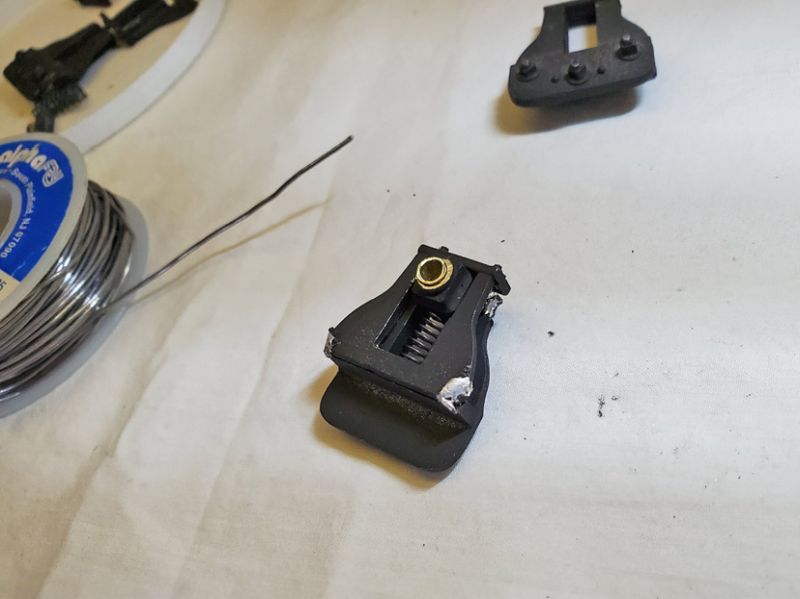
This is an Ozark wheel support with a very strong spring (from my little caboose project.) When it hits a bump, both wheels go up as the springs are too stiff.

I have a multimeter but don’t know the ins and outs of it. What exactly do I need to set it to and what am I looking for?

As we are on a roll, here’s the scoop. The multimeter can read ohms, a measure of connectivity. If you turn the dial to 10 ohms, (or 20, or whatever ohms it has,) and touch the probes together, it will read 0 ohms (zero). (Mine reads -1 if the probes aren’t touching anything.) So if you touch the wheels on opposite sides they connect through the motor (if all is well) and the meter will not read 0. If there is a short-circuit, then it will read 0.

The advantage of using a meter is that you can touch the various parts, like the wheel and a connecting rod, to confirm they are connected and conducting (they should be) and you can test various other places to see what happens.

https://randomnerdtutorials.com/how-to-use-a-multimeter/