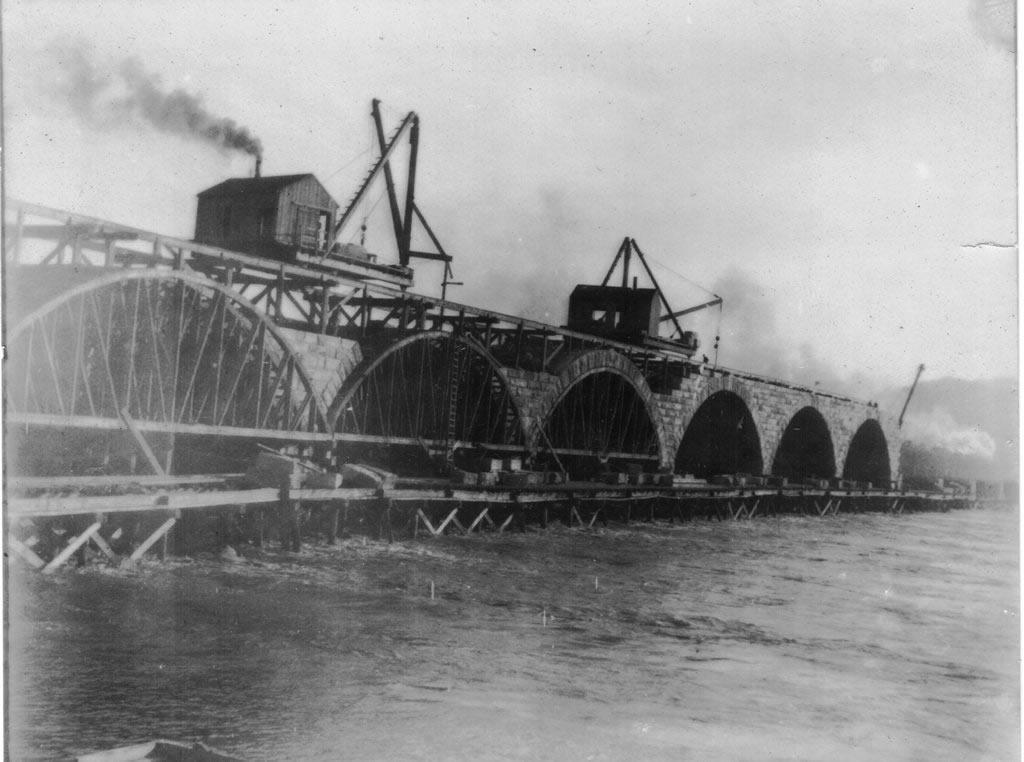
My personal favorite is the Rockville Bridge in Harrisburg, PA. It has stood for over a century, and still carries some very heavy freight traffic.
Regards, David Meashey
My personal favorite is the Rockville Bridge in Harrisburg, PA. It has stood for over a century, and still carries some very heavy freight traffic.
Regards, David Meashey
This is very cool. Shall we expect to see this bridge made using your CNC soon?
Dan;
My first thought was that the arches on that bridge were for carrying trolley wire or catenary. Henry Ford’s electrified railroad had similar arches, BUT the arches are not evident over the girder spans. So, I suppose the arches were just used to add strength.
Anyone else want to hazard a guess?
Best, David Meashey
I believe it’s called “flair”
I was first drawn to that bridge back in the early 90’s and over the years I’ve asked many about the arches and no one knows for sure. Someone speculated it was originally built with top supports straight across (16 feet clearance) and the arches were added later to allow for taller equipment.
My favorite bridge would be anything made of hot riveted steel and considered a trestle not a bridge. the higher the better and I have quite a few as my favorite.


Back in the day in the hood Dave !

I honestly think it was originally designed that way ( if it matters). I believe there are other examples but I cannot find them currently. It’s a pratt truss design that I would designate as a pony truss however with the arched connecting struts on top it kinda becomes a thru truss doesn’t it?
Remember a lot of your early bridge builders were usually somehow related to ship building. I think the design is European of some kind (British/French) not sure though.
Either that or the Canadian’s were ahead of their time thinking someday Superliners would need to access Mattawamkeag for switching opportunities.
Dave I think they may be called arched upper chords that are used for both structural support and aesthetic appeal.
In Oz they’re reportedly found on British built and Belgian sourced structures. It looks like our railways have avoided using them for catenary wire too.

Since viaducts have been brought up, the Thomas Viaduct of 1835, Elkridge MD, is still carrying CSX trains.

If you ever get over to England, their waterway system is something to behold. Early on in the Industrial Revolution people traded in riding by horse to travelling at the amazing speed of 4mph on a canal boat.
When the iron horse arrived, railways soon multiplied those speeds and lured passengers into railway coaches. The railways soon bought up many canals for their water needs as a source for steam. In many places in the UK you see aqueducts beside viaducts for that reason.
The Chirk aqueduct (below) is one such example. We travelled across the aqueduct straight into a tunnel at the amazing speed of 4mph as a train zoomed by.


A longboat cruise will be one of the signs. I went down the Youtube rabbit hole one week, WOW.
And while in the UK there are a bunch of railway preservation sites and cool narrow gauge up in the Welsh highlands.
could be. I’ve been told that and there are others like it in Canada but I have yet to see another.
EDIT: Just found one!
It just so happens there have been recent talk about running double stacks on that line.
Jon,
We’ve done it twice and it was the least expensive and most relaxing week we had. It’s supported by the lottery over there and they are reopening a lot of canals.
We’ve travelled into Wales and Scotland. Been able to moor in the city centres of Glasgow and Edinburgh.
We did it with just us 2 but the boats become quite affordable with 6-8 people. There were pubs at many locks if you didn’t want to cook for yourself.
Canal Junction is our Go-To planning site.
Another favorite of mine is the Nevada County Narrow Gauge crossing of Bear River near Colfax, CA.
Pictures from Gerald M. Best’s book, Nevada County Narrow Gauge.
First built in 1876 of wood construction it lasted a long time.
The new and more scenic bridge was built in 1908
This bridge stood 173 plus feet above the river and was 811 plus feet long.
Demolition time, August 23rd 1963. The railroad was defunct and the bridge was in the way for the construction of the Rollins Dam project. All the explosive charges were placed and then set off. When the smoke cleared there stood the bridge, slightly out of line but standing firmly. They attempted to pull the bridge over sideways with a tractor and long cable, but the cable broke and the bridge didn’t move.
Two more dynamite attempts only moved the bridge a few inches. They gave up on that idea and brought in oxy/ acetylene torches and cut all the main girders and beams and were finally able to pull it down. This ended the story of California’s best know narrow gauge railroad.
This lift bridge spans the Cape Cod Canal and this engineering marvel has always been my favorite. I have been over it several times on a train.
That’s crazy! It looks so fragile.

Ok, since Bill started this thread I thought I would share a video I made a few years ago which shows my fetish for bridges. Cliff, you wanna meet up about 1/2 way in Lancaster county I’ll take you into some of Pennsyltucky that many ignore or could care less about. Bridges make my butt hurt from thinking too much about the architecture and skill to make them.
IMO it’s a total lost art these days!
dnssʎ

Shut up Rooster !!