Yeah Cliff and Bill;
It makes me hungry for Bratwurst! Not on my diet, though. Donnerwetter!
Best, David Meashey
Yeah Cliff and Bill;
It makes me hungry for Bratwurst! Not on my diet, though. Donnerwetter!
Best, David Meashey
Rooster gives Cliff a timeout!
That’s pretty heavy duty stuff there man and a rabbit hole I didn’t need to go down.
I spent way too much time zooming in on that ACCURATE drawing from SA in 1886…
“Back in the day in the hood”.
The Holman loco, apparently built by Baldwin:

The Raub loco
And I thought Walshaerts valve gear was complicated. This is a “booster” loco, where small drive wheels help at slow speeds, and bigger drive wheels at high speeds.
I’ve really enjoyed checking out the museum page, Cliff. Thanks for posting it. This guy is having way too much fun.
I can totally see Cape Cod Todd’s blue crew building one of these on his route. He has the pictures of this crew sending in a crane to pick up cars off of the roof of buildings, allegedly sent there by his leaf blower (if I am not mistaken). 
Please forgive me if I am posting this here again, don’t remember. Instead of sails, ducted fan drive and ball-bearing wheels. Never had enough straight track to go full throttle.

Regards, David Meashey
Haha, that Holman loco is wild. I suspect it was about creating a low gear with “gear” ratios for tractive power, with the middle set between the mains and the trucks to keep the direction of the mains going forward.
If there were teeth involved, it almost makes sense in a convoluted way, but I would think in this case, the slightest bit of moisture would just have them slipping, defeating the purpose.
Maybe I am wrong, or missing something, just guessing from looking at the photo.
Dave, you got me thinking.
Is it a “gearing” reduction? I agree that the rotational speed definitely increases as you get nearer the rail. Like, if the driver is at 10 rpm, the wheels at the rail are really spinning. However, the circumference is also getting proportionally reduced; so circumferential speed is the same at the rail, I think.
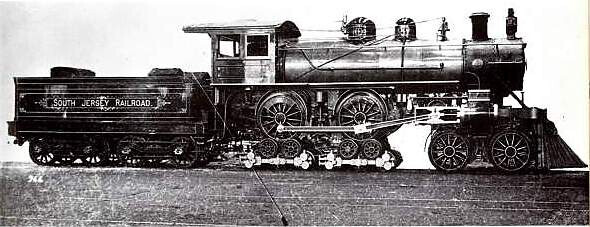
My guess is that their objective was to increase the contact area of wheels to rail, and thereby reduce slippage and increase traction. The lead truck and driver bogies could be sold as a retrofit kit.
I doubt that it worked though… The mass of the loco (to hold a wheel against the rail) went from being divided by 4 drivers, to divided by 12 mini drivers. Each of which had less mass to hold it against the rail. So I’d guess that it didn’t improve anything, but I could be way off base there.
Aside from that, like you say, the additional slippage at each wheel interface surely didn’t help. That, and additional bearing and other mechanical resistance with each axle, must have worsened everything. And there was the little problem of not fitting through tunnels and under bridges & stuff anymore…
Having said all that, it would sure be very cool to see a model of it running!
Hi Cliff, you are right, it would not be a reduction… I guess it would actually be a higher gear, so your explanation makes sense, more surface contact.
And yes, I thought about the height implications as well. That is quite a lift.
Folks;
I always was dubious about sail-powered rail cars. They would work fine in the direction of the prevailing wind, but how does one get back? You cannot tack on track! So how does one go back? Perhaps poling, as with a Venetian gondola (the boat)?
Just my $.02, David Meashey
one gets back by applied physics.
first - wheels on rails have much less resistance, than hull in water. so less applied force needed.
second - the less force one needs, the nearer one can tack into oncoming wind.
third - one does not (only) tack by directing the hull. one positions the sails, that the frontal wind does not push the sails in front of it, but so, that the frontal wind lets the sails glide in the opposite direction.
it is far more complicated, (for me) to describe, than to do and feel it.
there is a really big advantage to tack on rails, instead of water:
when misscalculating, you don’t need to know, how to swim after capsizeing…
IIRC the prototype would use the sail going up the mild grade and coast on the downgrade. This was on one of the Welsh slate railways.
Korm;
I have to confess that I have almost no boating experience, so I was unaware of the angling sail technique. Except for some time on canoes and kayaks, everything else I have been on over the water was powered. So chalk my inexperience to just that. Never had to deal with sail (except in mud puddles, perhaps). At 80 years old, the childhood memories are kinda’ dim.
Regards, David Meashey
French Western Railway No. 261 “L’Aigle”
Bottom line: a fascinating dead-end—great on paper, but compromised where it mattered: steam production.
Website also available in German 
Fürwahr, Fürwahr. überschön.
Another nice loco site, thanks Bill.
Imagine the horsepower it must of took to start a rotation on a wheel so big as that. 
Bruce you hit the nail on the head. Apparently quite underpowered. Very Jules Verne appearance though.


