I wonder if there was a point beyond “Because we can!”
Eric
I wonder if there was a point beyond “Because we can!”
Eric
Just like this one Eric!
Nice Photoshopping, Bill! Did you do those? 
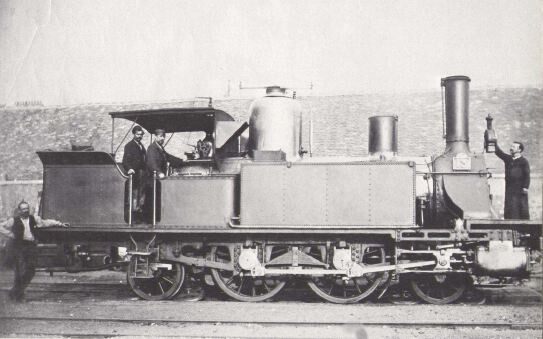
Found the original of your first one… 
Guys;
Just before the dawn of the 20th century, the Reading RR tried an express locomotive they called the “Bicycle” type. It was a 4-2-2 with a single large drive wheel. Bill’s fanciful 0-2-0 locomotives would be a load-balance nightmare. Even If the locomotive could run as shown, adding a train would probably throw it all out of balance. Works for battery and clockworks toys, but would come to a crashing halt in the full-sized world - too much mass to deal with.
Regards, David Meashey
Bill, this is close to your second loco. Can’t tell if it’s the same, it’s so heavily chopped, stretched and squished!
Back to post #2
0-4-0T
That’s funny Cliff. Only you and Dave could & would fact check me on the 0-2-0! 
It reminds me of the time we caught up with Dave at his favourite pub and you fact checked me on choosing seating at the steel drum table.
Bill;
Would one call that “Having a drink before the timpani starts?”
Ducking and weaving, David Meashey
I love that shot. Abe Lincoln, Loco Slayer.
Dave did you mean tinnitus? 
Bill;
Only if it makes one’s ears ring.
Regards. David Meashey
P.S. When will the kettle drum player say, “And now Spaceball One is Mega Maid!”?
This is my “Juggernaut”. It’s a weapon of mass destruction on rails. Inspired by an episode of the same name on the “Wild Wild West” TV show, and the Steampunk fad that was becoming popular. I kit-bashed an original Walt Disney hard rubber model of the submarine in Disney’s movie “20,000 leagues Under the Sea”, by Jules Verne. (from Ebay). It has an explosive harpoon in front, and rakes on the cow catcher for ripping and shredding enemy trains. It features two Gatling guns and a rocket in back for extra power while ramming the enemy. And it goes down tracks into the water to become a submarine.
John, excellent work!
It would have been right at home in our Mik’s Challenge earlier this year.
_lbr_4.jpg)
I like this one because it has meaning to me.
Editing to say…It used to work the ridge just over the hill from Johnny (concrete) R’s current homestead.
Don’t let him fool ya’ that he’s related to a concrete company owner in Jersey ( I believe)
lol
This is Spooner’s Boat
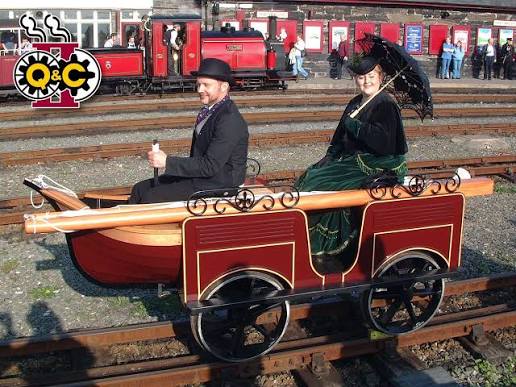
If you think you’ve seen every possible type of railway vehicle meet Spooner’s Boat — possibly one of the strangest vehicles ever to run on rails.
Built for the Ffestiniog Railway in North Wales, Spooner’s Boat was essentially a small boat-shaped railway car fitted with wheels and a sail. The Ffestiniog which is still running as a tourist railway, was originally an industrial slate railway, and its steep gradients made gravity a useful source of motive power for the boat carriage. The return section of the boats trip was powered by gravity. On flatter sections, the Boat could reportedly use its sail to take advantage of a favourable wind.
The Boat’s career ended dramatically in 1886, when it collided head-on with an ascending passenger train. The original vehicle was destroyed. This replica was constructed in 2005, bringing this eccentric piece of railway history back to life.
So the big question is…
Does a sail-powered, gravity-assisted rail vehicle count as a locomotive?
Bill;
I’d certainly say it counts as a self-propelled rail vehicle, linking it to motor cars, hand (or lever) cars, doodle bugs, and galloping geese. Nice photos.
Regards, David Meashey


